


John “JR” Reardon, the veteran equipment manager for the Rutgers University baseball program, makes a pitch for the iconic sign on the bridge connecting New Jersey and Pennsylvania over the Delaware River along U.S. Route 1. It reads, “Trenton Makes, the World Takes.”
But what’s the link between a trestle bridge and baseball?
“The baseball world takes the Blackburne mud from the Jersey side of the Delaware further south and has no equal in legally prepping a baseball for pitchers,” Reardon says.
He’d know. He uses Lena Blackburne Baseball Rubbing Mud to prep some 200 dozen baseballs a season for the Scarlet Knights. In a 19-inning Mother’s Day win over Notre Dame in 2003, the teams used 16 dozen balls. On average, he’ll rub down 18 dozen for a three-game Big Ten Conference weekend series.
Reardon’s not the only fan of this very special mud. New Jersey doesn’t have a Major League Baseball team, but a bit of the state’s geology and ecology—sediment dredged from a decades-long closely guarded secret Delaware River Basin tributary in South Jersey—is in every MLB, minor league and independent baseball team’s clubhouse, with trickle-down to college, high school and youth league teams in time for opening day. Even the Little League World Series uses it. In the last decade, there’s also been trickle up into the National Football League and back downstream into its feeder systems.
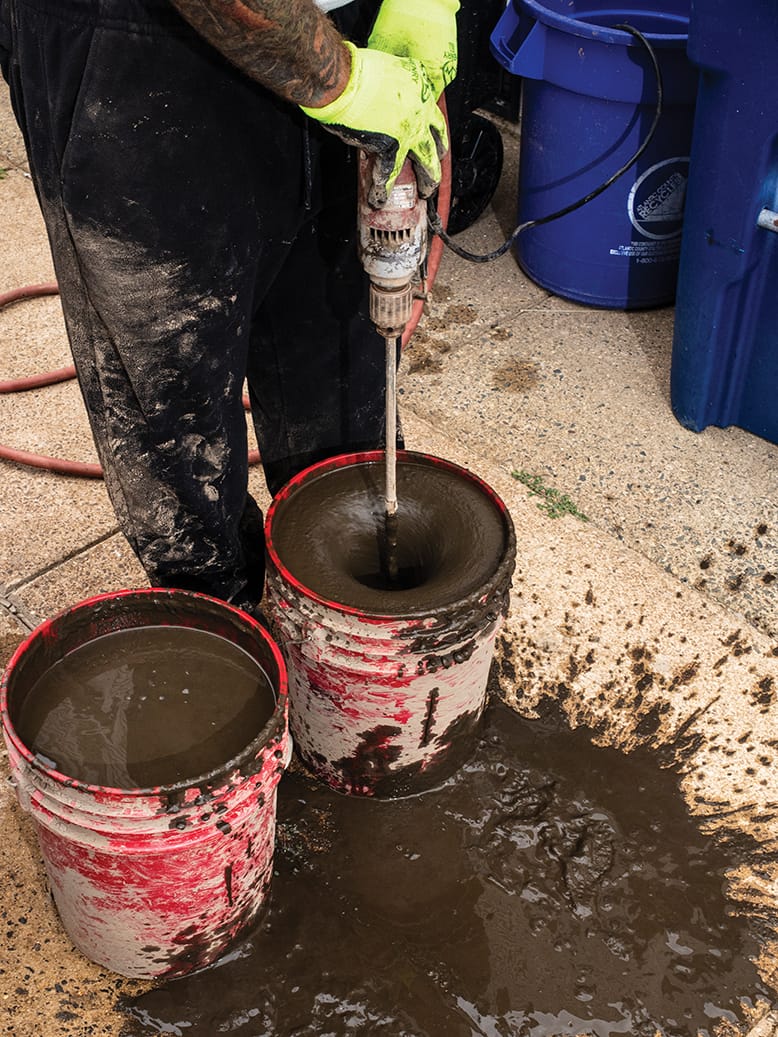
The mud is washed by adding clean water and mixing it with a drill and paddle. Photo: Bryan Anselm
But why dull down new baseballs (and footballs, making it a year-round business) by rubbing mud into them? Because they’re too new, slick and glossy, and they lack grip. Put simply, they require conditioning before use.
Like many stories, this one starts with a tragedy. In 1920, Cleveland shortstop Ray Chapman died after a wild pitch hit him in the head. By 1929, the National League required umpires to soil balls to improve safety. Initial remedies included bathing baseballs in infield dirt, shoe polish, or even tobacco juice. Experimenters struck out. The dirt scratched the leather; the polish and spit made the balls too dark to hit.
Then, in 1938, Palmyra’s Russell Aubrey “Lena” Blackburne, a superb defensive journeyman pro infielder, then coach, manager and scout, remembered a fine, smooth mud with some grit from his childhood days along the banks on the Jersey side of the Delaware River. He and John Haas, a friend who would become heir in 1968 to the eventual mud business, once swam and fished there. The miracle muck was so effective that, by the 1950s, every MLB team was using it. In 2022, the league mandated at least a 30-second rubdown for 156 balls three hours before game time.
“He tried it on a lark, took some into the Philadelphia A’s clubhouse, and umpire Harry Geisel worked with it—and the rest is history,” says the now decades-long owner/operator and president of Lena Blackburne Baseball Rubbing Mud, Longport’s Jim Bintliff. A grandson of Haas, who left the business to Bintliff’s parents, Burns and Betty, Bintliff plans to do the same for his four children. The youngest, Rachel, is taking the lead among her siblings, Jason, Vanessa and Abbie. “It’ll take that many hands, and they’re gonna have to deal with titles,” Bintliff says about the transition. “Maybe they’ll have a mud fight to decide.”
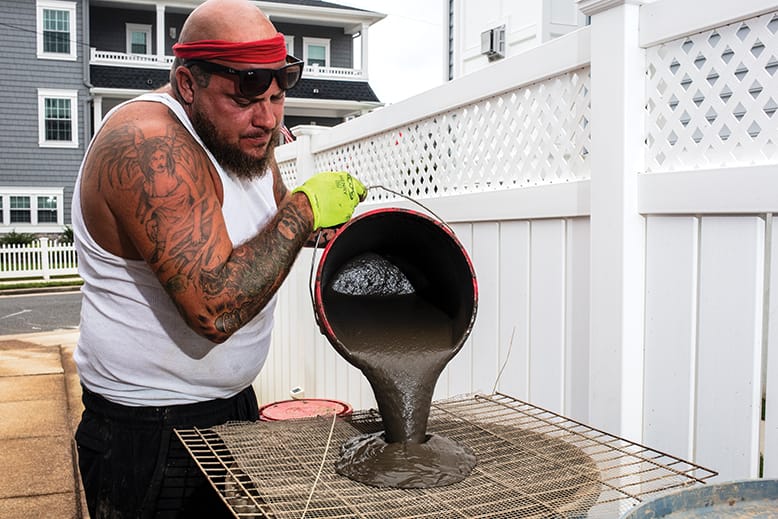
Leaves, sticks and stones are removed. Bryan Anselm
Now 69, Bintliff was a full-time printing-press operator before retiring in 2015, so his hands have always been dirty. The mud washed off; the ink didn’t. Then again, growing up in Willingboro, the family’s laundry room was its mud room—“and it was a real mud room,” he says.
Bintliff was nine years old when his maternal grandfather, John Haas, moved in. That year, he helped him fill a kettle with mud. “That was my introduction to the mud; then, through the years, I watched my father harvest and process it (then once a year in the fall) in our laundry room, then ship it every spring from our kitchen table,” he says.
As a teenager, he’d help harvest with his father, a retired New Jersey Turnpike maintenance man, and eight siblings. On family boating outings, they’d wait for the right sun-drenched low tide, especially in September and October, when they’d “take care of the mud.” When he was 15, his mother declared Bintliff, a middle child, the successor.
He took over harvesting, then shipping, too, in 1980 when his parents retired and moved out of state. In 2000, Burns said he was done and turned over the business records—a pile of wrinkled papers with names and phone numbers—of only professional baseball teams. There were no colleges, no trickle down.
“My father didn’t advertise, and he didn’t like talking about it,” Bintliff says.
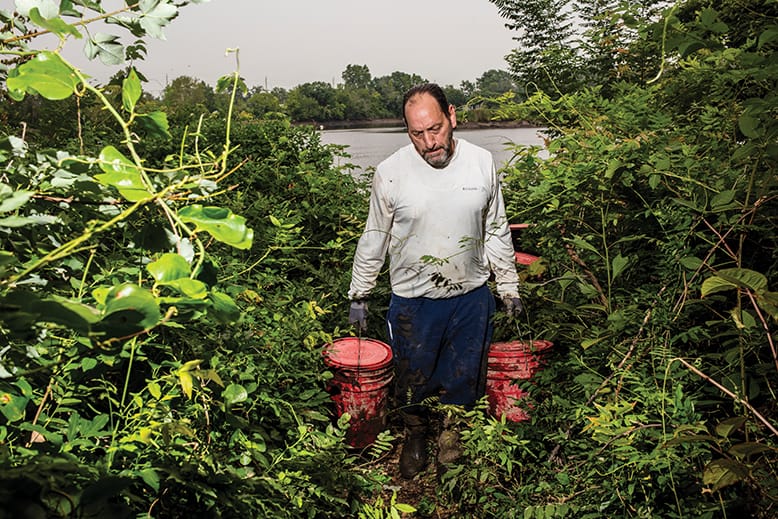
Mud is carried from the riverbank. Photo: Bryan Anselm
At first, to bolster business, Bintliff and his late wife, Joanne, mailed 1,000 introductory letters to colleges, the only direct marketing the company ever tried. “We had maybe four replies,” he says. Then, in 2001, they added a website. Within the first year, business quadrupled and has grown ever since.
Around 2012, business bled into football, beginning with the Seattle Seahawks, who’d borrowed some mud from the Seattle Mariners. “The next year we added the (San Francisco) 49ers, and every year it’s been another team or two,” Bintliff says. Once, two or three harvests a year were enough. Now, it’s every month. He’s shipping daily to meet the needs of thousands of customers.
To harvest, he’ll reach the sacred spot, back his truck in, and meet his help, who do the heavy lifting of the mud-filled, five-gallon buckets. They fill, on average, 20 of them, then return an hour’s drive back to Longport for processing. “It’s that complicated,” Bintliff jests.
The challenge is reading the tide. For that, he uses an online tide chart. Prolonged rain is a problem; the tide doesn’t get low enough. Never a supply concern, the tide’s natural ebb and flow sustainably replenishes the geology. If there’s a limitation, it’s trucking only so much mud per trip, then letting the area settle before returning. “I’m not going in with a steam shovel,” Bintliff says. “I’ve had my guys say, ‘Why not bring another truck and do 40 buckets?’ For one, my back can’t handle that—and I’m the only one shoveling. There’s also a limit to how deep we can take the sediment off the top of the bank. If too deep, it gets too gritty and smelly. It’s an art.”
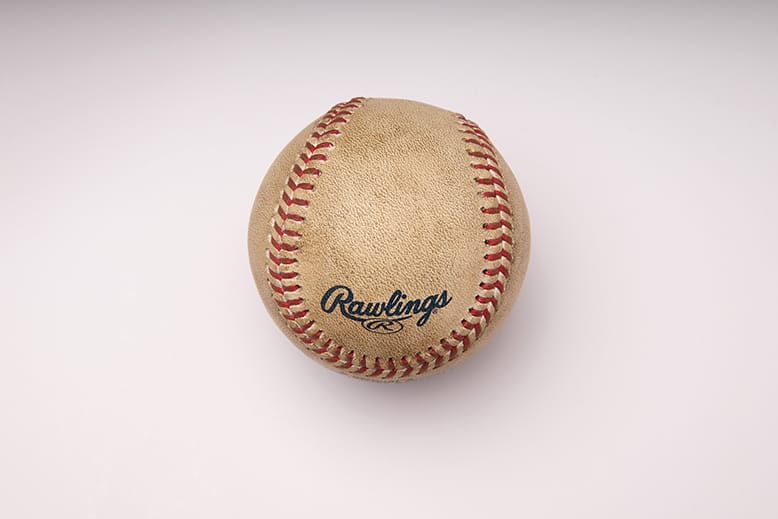
A MLB ball treated with Lena Blackburne Baseball Rubbing Mud. Photo: Courtesy of Major League Baseball/Daniel Shirey
It’s one the Delaware River Basin Commission in West Trenton doesn’t mind, permit or regulate. In fact, it celebrates the mudding practice as “baseball’s dirty secret” and calls it “a wonder of the watershed” and “a door opener to talk about the river,” says Elizabeth Koniers Brown, the commission’s director of external affairs and communications.
“At its core, this product and practice is a fantastic way to introduce our shared water resources to a wider audience, say, those with a keen interest in sports,” she says. “This speaks to the Delaware River as a hard-working river for the watershed beyond its use in shipping, recreation, or as a supplier of public water. It’s a hometown-pride thing for us—the whole country is benefitting from something that starts here.”
A member of the commission’s Our Shared Waters, a stakeholder-outreach group, Bintliff’s been asked to speak at commission events, and they brag about his business in print and social media. “All I leave are footprints,” he says, explaining that he keeps the spot secret not because he’s worried others will also excavate and profit, but to keep it from getting trampled and littered. “You can’t find this mud anywhere else in the world, and you can’t find it anywhere outside South Jersey—yet this little piece of New Jersey has been all over the world.”
Trucked back to his Longport garage, excess river water is drained, then fresh water added before the glob is screened to remove leaves, sticks and stones. The mix settles again, the fresh water is drained, and then the process gets proprietary. Other “absolutely organic” materials are mixed in with a paddle on a drill, creating a cake-like batter—what Bintliff calls a “cold cream or maybe a stiff pudding.”
Each bucket yields about 30 pounds of product. Sold in three-pound, two-pound and eight-ounce plastic containers, retail prices have never topped $100 per large container and haven’t increased in 12 years. MLB teams typically order four three-pound containers, two for spring training and two for the home season. “Back in the ’70s, my father was offered $1 million by an equipment company to sell out, and still kept his price down, and did it out of tradition,” Bintliff says. “He always loved the game.”
Client Ryan Mulvihill’s Grippy Football Prep in Williamstown uses the mud to condition 300 footballs a year, about 80 percent of which remain in New Jersey. They’re used in prominent programs at Glassboro High, the defending back-to-back NJSIAA Group 1 champion, and Washington Township High, the defending Group 5 state champ.
A Williamstown native, even he doesn’t know where Bintliff’s supply pit is. “But when we go over New Jersey bridges, my 8-year-old daughter (Mia) says it smells like your mud and asks, ‘Is this where he gets it?’ ” he says. “My wife (Samantha) loves the beach, and she says it smells like the bay.”
Mulvihill, who is the receivers’ coach at perennial Class 6A Pennsylvania state champion St. Joseph’s Prep in Philadelphia, has been rubbing down footballs for five years, two as a business where he maintains a simple motto: “From youth to pro, if you throw it, you know.”
“What I do is black magic,” he says. “You’re playing with the mental aspect of a quarterback. You can give him a slippery ball, but with a grippy ball, his confidence is through the roof.”
You can risk—and double the cost of—a $100 football by rubbing mud on it, but it’s a good investment if conditioned right because it prolongs its life. If not, it becomes a waterlogged ball. It takes a day’s work per ball. “We’re speeding up the leather process,” Mulvihill explains. “The sand’s what really does the mudding—working the sand through leather, like sandpaper, as the leather softens and turns color from a light tan, an almost burnt orange, to a deep-dark brown. For a baseball, it’s like the ball’s been in the tanning booth.”
Of late, there’s a proven science behind the effectiveness of the natural balance of sticky clay and sand particles that makes Bintliff’s mud spread evenly, like toothpaste, while also generating a textured surface that gives pitchers (and fielders) better control. A recent study published in the Proceedings of the National Academy of Sciences was engineered by geophysicist researchers at the University of Pennsylvania to evaluate the Garden State mud.
First, they analyzed the mud’s adherence (its stickiness and resistance) with an atomic-force microscope. Then, researchers placed some on a rheometer, a machine that spins the mud to measure its viscosity. A third test estimated the friction between human skin and adding a baseball; it involved constructing a synthetic rubber finger and a drop of whale oil to simulate oils secreted by human skin. The “finger” was then pressed to strips of leather baseballs, then re-spun on the rheometer.
Rutgers’s Reardon says it’s all mental with pitchers. “Like pine tar to hitters, the mud’s a must for all pitchers,” he says.
“Similar to the getting-it-just-right Goldilocks Syndrome, a game ball can’t be too light (in color), nor too dark, and with NCAA Rawlings game balls fetching nearly $100 a dozen, you can’t afford too many mistakes,” he says.
Bintliff, a recent inductee into the South Jersey Baseball Hall of Fame, is not yet a member of the National Baseball Hall of Fame, but he was invited there over induction weekend in 2010 “to talk mud,” he says. “That’s the weekend I signed my first autograph.”
J.F. Pirro has written about sports and recreation for 45 years and coached elite-level baseball for almost 40 years.

Dog-owner teams from the Garden State have won the obedience championship in eight out of 10 years.
Richard L. Greene has a massive, 750,000-matchbook collection with thousands of New Jersey match covers.
The Garden State’s dining scene has it all—from incredible Italian food to amazing Asian fare, French cuisine and more.

Where to imbibe, celebrate and enjoy live music this month.
