


In a sclerotic and divided Congress, committee assignments can go a long way towards getting anything done. And thanks to a confluence of retirements and deaths, New Jersey is facing the prospect of going without any seats on two of the House’s most influential panels: Ways & Means, which governs tax policy, and Appropriations, which determines how the federal government’s money is spent.
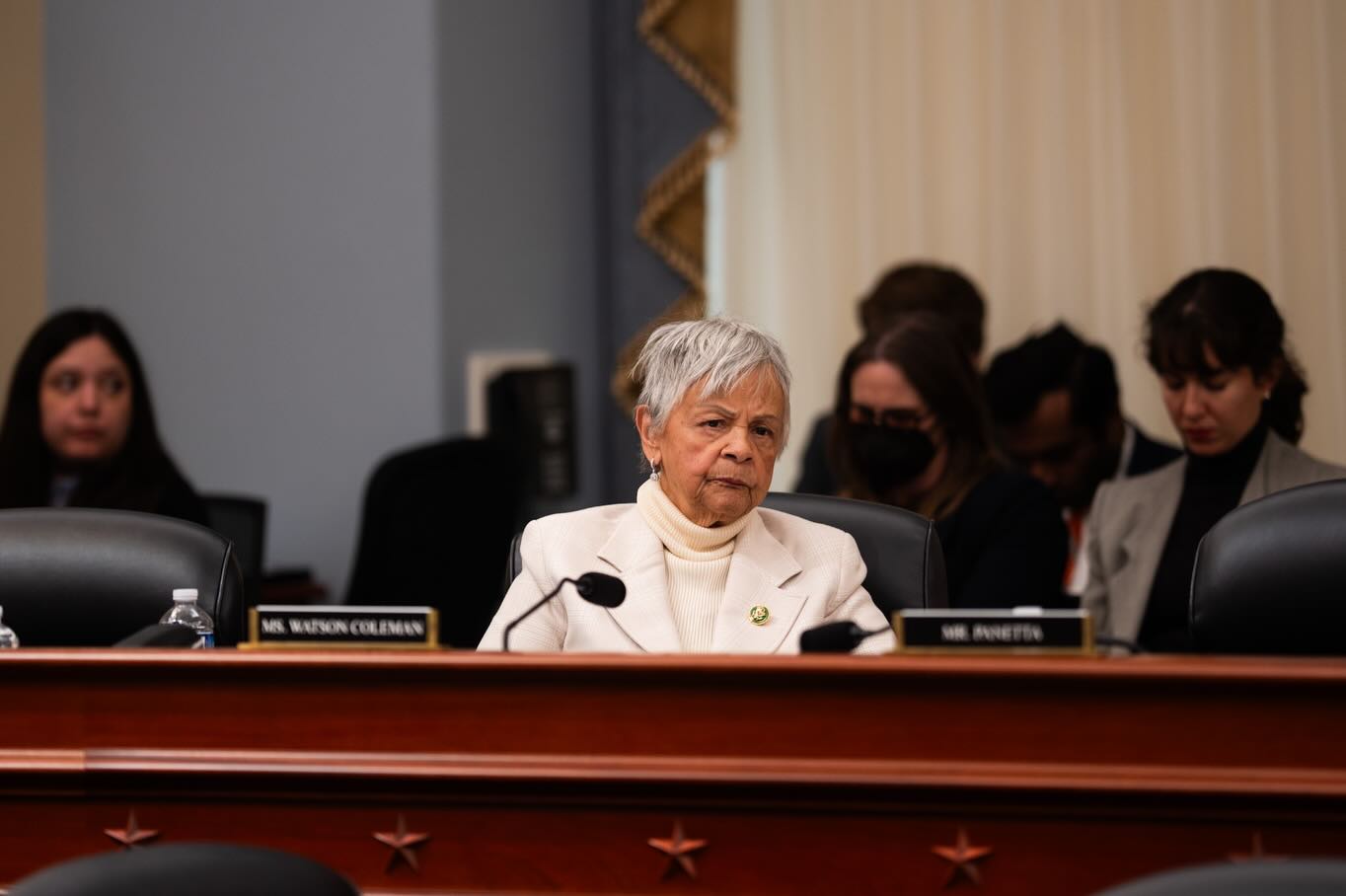
Rep. Bill Pascrell (D-Paterson)’s death in 2024 left New Jersey without any representation on Ways & Means, where he had served for close to two decades and risen to become a subcommittee chairman, and the upcoming departure of retiring Rep. Bonnie Watson Coleman (D-Ewing) endangers the state’s single spot on Appropriations. Watson Coleman, who has been New Jersey’s lone appropriator since 2019, said it’s crucial for New Jersey to retain its influence over the federal budget.
“Because New Jersey gives up so much money, we have to have a say about getting some back,” Watson Coleman said. “So I think it’s very important that New Jersey is sitting on all important committees. We’re an important state.”
Watson Coleman’s committee spot has proved especially important in recent months, as Democratic and Republican appropriators have broken through a years-long logjam to draft a series of bipartisan funding bills ahead of a January 30 shutdown deadline. Every member of Congress eventually gets to vote on those critical bills, which also include earmarks for thousands of state-specific projects, but only the select few who serve on Appropriations get to write them.
Whether or not New Jersey is able to snag seats on either or both committees will ultimately be up to House leadership, which considers a variety of factors when making assignments. But there already appears to be a concerted effort among the New Jersey delegation, especially its three Democratic freshmen, to maintain Garden State representation.
Rep. Herb Conaway (D-Delran), who was recently chosen for a spot on the Armed Services Committee, said he believes sitting on Appropriations would give him a better ability to advocate for New Jersey’s military installations: “It’s certainly something I would consider.”
“It has been suggested that it would be important, in supporting the work I need to do on House Armed Services with respect to our defense posture and New Jersey installations, to move over to Appropriations, to help make sure that there’s a follow-through on the appropriations end for things that we need to do,” Conaway said.
Reps. LaMonica McIver (D-Newark) and Nellie Pou (D-North Haledon) were both more coy, declining to say much beyond the fact that they’re considering their options. (Watson Coleman was blunter about McIver’s aspirations: “I know that LaMonica is interested in serving New Jersey on Appropriations,” she said.)
Both congresswomen have advantages over many of their fellow first-term Democrats: McIver was elected in a September 2024 special election, giving her a seniority edge over 70 of her colleagues, while Pou represents a swingy House seat that voted for Donald Trump in 2024, which could be a bonus assuming she wins re-election this year. At 39, McIver would also stand a better chance than her older colleagues of sticking around on the committee long enough to accrue real power and possibly become a subcommittee chair.
Most of New Jersey’s other House members professed no interest in switching committee assignments, including all three of its Republicans. But two longer-serving Democrats, Reps. Donald Norcross (D-Camden) and Josh Gottheimer (D-Tenafly), said they were keeping their options open despite having settled into other high-profile committees during their House tenure.
“I’m going to make sure New Jersey is well-represented,” Norcross said.
New Jersey is also set to elect a handful of new members this year, but first-term members rarely get such coveted seats; Ways & Means currently has zero freshman, while Appropriations has one.
The one exception, though, is former Rep. Tom Malinowski, who if he wins the ongoing special election in the 11th congressional district would retain some of his seniority from his prior stint in Congress. Asked about committee assignments, Malinowski said he won’t focus on that until after the February 5 Democratic primary but added that he’d expressed interest in an Appropriations seat in the past.
And then there’s the Senate, which has a pair of equivalent committees that similarly dictate how the government raises and spends its money (though the taxation body there is called the Finance Committee). Ever since disgraced ex-Finance Committee member Bob Menendez resigned from the Senate in 2024, New Jersey has lacked representation on either of those committees, too.
Under House Democratic rules, prospective committee members are typically put forward by the Steering and Policy Committee, which “shall consider all relevant factors, including merit, length of service on the committee, degree of commitment to the Democratic agenda, and the diversity of the Caucus, including appropriate representation of the Caucus’ ideological and regional diversity, in making nominations for committee assignments.” Steering and Policy’s choices are then subject to ratification by the full caucus.
Since regional diversity is a factor, New Jersey’s committee spots may be contingent on what happens in other nearby states in this year’s elections. And former Rep. Steve Rothman (D-Englewood), who held an Appropriations seat for 14 years, told the New Jersey Globe that political factors like fundraising and frontline status can be at play, too.
“I raised a lot of money for the Democratic leadership, which is what one does – either as a Republican or a Democrat – to get on those kinds of committees,” Rothman said. “And that, along with there being an opening for the regional representative from the Atlantic region, as well as the strong endorsement of [Maryland Rep.] Steny Hoyer, was how I got on the committee.”
Both Appropriations and Ways & Means are “exclusive” committees, prestigious and high-intensity committees that are intended as the only committee assignments for the members who sit on them. Anyone who joins one of those top committees, then, would likely have to leave behind most or all of their other assignments.
The other two exclusive committees already have solid New Jersey representation: Gottheimer sits on Financial Services, which regulates banks and the financial industry, while Reps. Frank Pallone (D-Long Branch), Tom Kean Jr. (R-Westfield), and Rob Menendez (D-Jersey City) all hold seats on Energy & Commerce, which has jurisdiction over a massive range of policy issues. (Menendez won an intense intra-party fight for his spot last year; the Steering and Policy Committee had already awarded six out of seven open slots, and Menendez had to beat nine other Democrats for the seventh.)
Historically, New Jersey – the nation’s 11th-largest state – has typically had at least some representation on all four committees, which together account for a huge amount of what Congress gets done any given year. All four committees have had at least one New Jersey member at every point in the 21st century except for Ways & Means; Pascrell’s arrival on the committee in 2007 marked the first time New Jersey had a Ways & Means seat since the late Rep. Dick Zimmer (R-Delaware)’s retirement in 1997.
And as makes sense for a heavily taxed state that sends more to Washington than it receives in return, New Jersey has guarded its berth on Appropriations particularly jealously. Watson Coleman, Rothman, and former Rep. Rodney Frelinghuysen (R-Harding) – who briefly served as the committee’s chairman and was previously its Defense subcommittee chair, known in House parlance as a cardinal – spent decades promoting New Jersey’s interests on the committee, and Rothman said he hopes that legacy will continue.
“It was a stone-cold privilege to be able to fight for what my communities and country needed,” Rothman said. “Now that Congresswoman Watson Coleman is retiring from the Appropriations Committee, it would be a real loss for New Jersey. I hope future New Jersey House members will be able to address that.”
