


 Listen to this article
The basics:
- NJBIZ hosted a virtual roundtable on New Jersey construction and development trends
- Panelists discussed how tariffs are affecting project costs, timelines and financing
- Rising energy costs and power availability were cited as growing risks for projects
- Health care and industrial sectors remain active despite cost and infrastructure pressures
As part of NJBIZ’s latest virtual discussion, real estate professionals spoke about current trends in New Jersey’s busy construction and development industry.
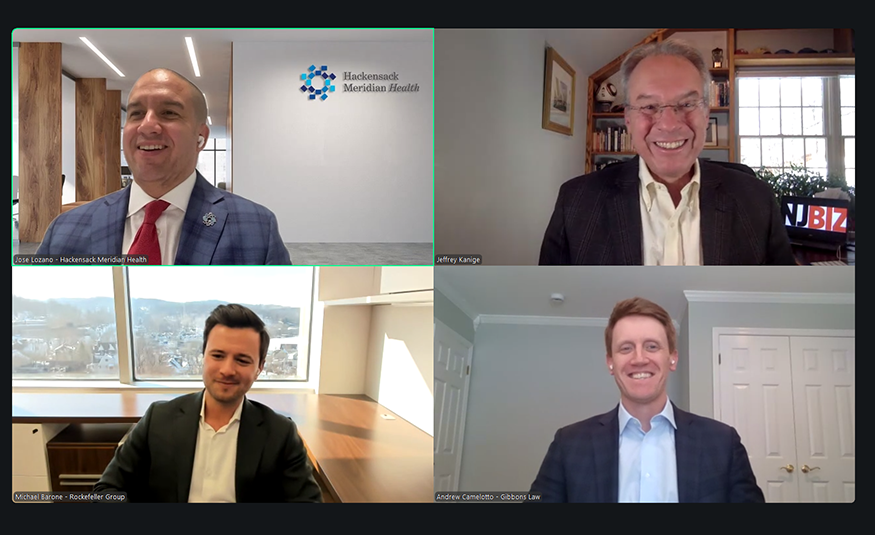
Moderated by NJBIZ Editor Jeffrey Kanige, the Dec. 16 panel featured:
- Michael Barone, project manager for Rockefeller Group‘s design and construction team in Morristown
- Andrew Camelotto, director of Newark-based Gibbons PC‘s real property group
- Jose Lozano, executive vice president and chief growth officer at Edison-headquartered Hackensack Meridian Health
During the 90-minute roundtable discussion, panelists addressed how tariffs affect project costs and timelines, present and future workforce challenges and the overall lending landscape for construction.
A more detailed recap will appear in the Jan. 5 issue of NJBIZ.
A taxing issue
With commercial real estate historically considered to be one of the state’s economic growth drivers, the industry has kept a close watch on what impacts the Trump administration’s announced tariffs could have, according to panelists.
Barone said, “I’ll come at this from an industrial development experience because frankly the projects are so copy and paste that you kind of get a really good sense of what a warehouse should cost and you get really good price trends over the years. When tariffs dropped back in April, there was a lot of uncertainty in the market … There was a wait-and-see mentality around it because, as we know, it seems like every few weeks or at least months, tariffs change and suppliers are able to work around certain restrictions by finding different routes to import products.”
According to Barone, while material costs for industrial construction are up about 4% this year due to tariffs, higher steel and aluminum prices, rising electric and MEP (mechanical, engineering and plumbing) costs and steady inflation, a slowdown in construction starts has helped offset some of the impact so far. However, as construction activity recovers, those accumulated cost pressures could compound over the next year or two and begin to more significantly affect developers and builders, he said.
Replay: Construction & Development
Click through to register to watch the full panel discussion!
Lozano said, “Health care is not slowing down in any shape or form. And it’s not just Hackensack Meridian Health. You’re seeing this across the country as much more health care is being done outside the four walls of a hospital, we’re seeing a burst of ambulatory care centers. Ambulatory care centers meaning much more of the services being provided not on the hospital campuses, but having mixed specialties, primary care, urgent cares.”

Budget uncertainty
Because medical supplies are globally sourced and not exempt from federal trade policies, many providers are taking a wait-and-see approach, he said. As a result, tariffs and supply-side pressures have affected the cost and availability of medical equipment, technology, and furnishings, even if construction has been less affected, according to Lozano.
Want to recognize an industry leader?
Nominations are now open for the 2026 NJBIZ Leaders in Real Estate, Construction and Design and Top Projects awards. Find out more here.
In the construction space, Camelotto said tariffs’ effect on financing has created budget uncertainty and pushed risk down the chain from lenders to borrowers, contractors and subcontractors. And while some contractors are more eager for work due to a slowdown, uncertainty over costs, sourcing and timelines complicates deal-making, he said.
“I would also say the uncertainty generally seems to have the effect of making construction and development more challenging because of the trying to predict the end user at the end of your construction cycle. So, I think that’s another area where it’s become more challenging in that you have a lot of companies that they’re not quite as committal as they might otherwise have been if they know where things are going to be in the next three to five years,” he explained.
Power moves
Considering that health care and industrial properties require a lot of power to operate, panelists addressed ways the sectors are trying to deal with rising energy costs.
Lozano said, “We run seven days a week, 24 hours a day. Unfortunately, we do not get the luxury of closing down for the holidays. And so what we at Hackensack Meridian Health did a couple of years ago, we significantly invested on sort of our own energy master plan and we started the process of investing in solar panels and battery power storage to be able to control our peak times and then moving us into off peak times to try to minimize our overall costs.”
As the largest health care network in New Jersey, HMH’s statewide footprint includes 18 hospitals and more than 600 patient care locations. According to Lozano, energy costs on an annual basis for the network could run upwards of $60 million.
Power availability has also emerged as a major risk for industrial and warehouse projects, especially in the southern part of the state due to long delays caused by strained infrastructure, Barone said.

“New Jersey’s attractiveness as a data center market is purely based on proximity. It is not a cheap power market and I believe that the majority of the hyperscalers you hear about are going to be looking in Pennsylvania and other states in the Northeast and Midwest for the larger facilities … And I don’t see a way that without government assistance that those costs can be competitive with the current limitations on the grid,” he added.
“Pricing for feasibility studies has increased. I know that a lot of people at the state level and at the utility companies themselves are working on this very real demand supply imbalance and we are just along for the ride at this point. I will say that we’ve gone so far as to explore onsite generation from gas turbines and solar to battery storage that we would never have looked at three years ago just to support lease up on these sites,” Barone said.
Reliance on the grid
And although rooftop solar and battery systems can help optimize energy use and support the grid, current technology cannot fully replace a reliable grid connection, both Barone and Lozano explained. Especially in sectors like health care, multiple layers of redundancy are required, making continued dependence on the electric grid essential despite growing use of onsite generation, they added.
Camelotto said, “I think it’s going to become the No. 1 issue in the next several years for construction development in New Jersey.”
“I think the exploration of both onsite and offsite in close proximity, either private power or whatever it would be, is something that I’d like to see the state explore in earnest … there just needs to be more of that collaborative effort, I think both in the regulatory side and the practical solutions type front to try to address the issue.”
I think [grid reliability is] going to become the No. 1 issue in the next several years for construction development in New Jersey.
– Andrew Camelotto, director, Gibbons PC real property group
Ahead of taking office in January 2026, Gov.-elect Mikie Sherrill has made it clear that energy is a priority for the state.
Formerly president and CEO of economic development nonprofit Choose New Jersey, Lozano said, “I think it’s a little bit on the early side of the administration, even though they’re take office in 30-some-odd days. So, we’ll see what the proposals tend to roll out, but I think it’s pretty obvious. I think they have to diversify the supply.”
