


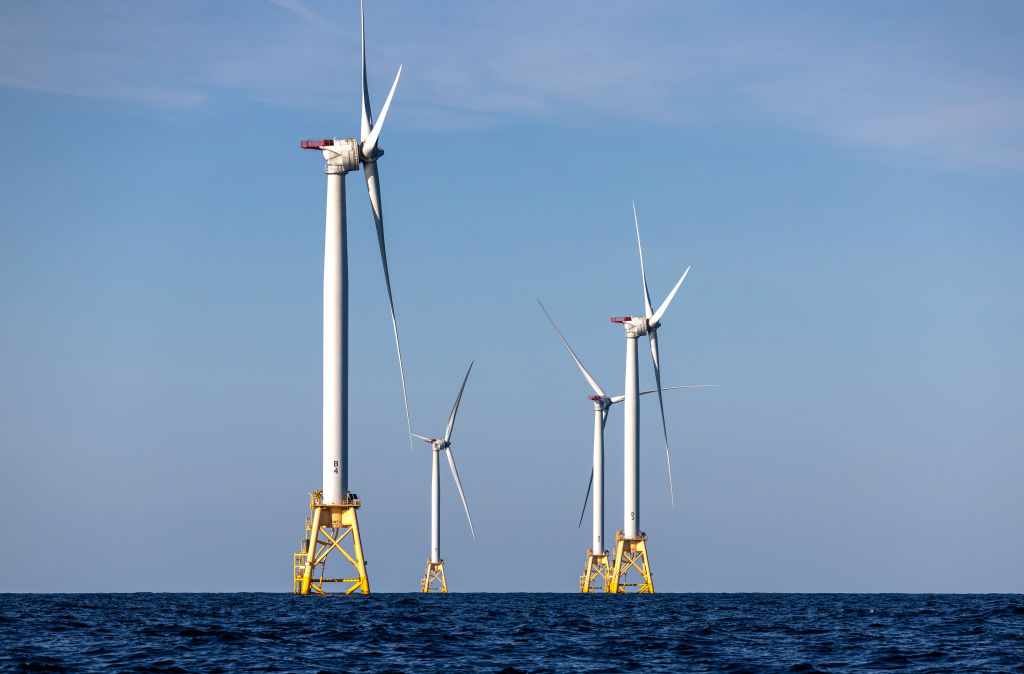
A Massachusetts federal judge found an executive order indefinitely pausing leasing and permitting for wind energy projects was unlawful. (Photo by John Moore/Getty Images)
A federal judge struck down an executive order issued by President Donald Trump that indefinitely froze permits and leasing for wind energy projects, finding federal agencies had neither explained nor justified the regulatory about-face that followed the order.
Federal agencies’ decision to block leasing and permitting for wind projects was arbitrary and capricious because the agencies did not provide an explanation to justify reversing decades of past practice on wind energy permitting, the judge said.
“The Agency Defendants were required, at minimum, to ‘provide a reasoned explanation for the change’ and to ‘display awareness that [they were] changing position,’” Massachusetts District Court Judge Patti Saris ruled. “They failed to do so.”
Proposal for ratepayers to subsidize nuclear development gets cold reception
Saris’s order comes in response to a suit filed by New Jersey, 16 other states, the District of Columbia, and a New York clean energy group that collectively alleged federal authorities violated the Administrative Procedure Act, which governs how federal agencies can impose regulations.
State officials argued the feds failed to explain or justify reversing decades of regulatory policy around wind energy projects, a failure the plaintiffs said risked compounding recent rises in electricity costs.
“At a time when utility prices are skyrocketing, Trump’s job-killing freeze would only increase costs,” Attorney General Matt Platkin said in a social media post. “Proud to fight — and win — for NJ families in court.”
Gov. Phil Murphy, who made wind a cornerstone of his energy policy, celebrated the decision.
“The governor is pleased that the federal court sided with us in blocking the Trump Administration from indefinitely halting offshore wind energy approvals. We must keep fighting for this vital clean energy resource, which would lower electricity costs for families and businesses and bring thousands of jobs to our state,” said Stella Porter, a spokesperson for Murphy.
The judge found a recent order from the U.S. Supreme Court that held agencies do not need a reasoned explanation to justify following executive orders stemming from authority explicitly and exclusively granted to the president by Congress does not apply in this case.
Unlike in that case, which turned on a challenge to a Trump executive order that ended a policy allowing transgender people to update gender markers on their passports, regulators in the wind matter were acting on their own authority at the president’s direction, Monday’s ruling says.
“Here, the Agency Defendants concede that no statute expressly requires them to follow rules prescribed by the President regarding wind energy authorizations,” the judge wrote.
Administration officials told the court that the review called for by Trump’s order was ongoing but could not provide any timeline for the probe, the judge said.
The freeze’s indefinite nature also violated the law, Saris said.
Portions of the Administrative Procedure Act require regulators to speedily process applications for permits and other licenses and rule on other matters before them within “a reasonable time.”
“While a President may direct a reappraisal of permitting practices after a change of administration … the Agency Defendants may not, as they have done here, decline to adjudicate applications altogether, for an unspecified time, pending the completion of a wide-ranging assessment with no anticipated end date,” the judge wrote.
The order itself presented no explanation for the freeze, Saris said. Instead, it cited vaguely defined potential issues with wind permitting and environmental reviews.
Trump’s order, issued on the day of his second inauguration, spelled doom for offshore wind projects that had already faced hurdles like rising costs, lengthy supply chain delays, and some local opposition from people who feared wind turbines’ effects on ocean views or marine mammals, though the latter has not been linked to wind projects.
Trump’s wind order froze permitting and leasing for all but one of New Jersey’s offshore wind projects.
In September, the administration intervened in a suit brought by state offshore wind opponents that sought to reverse approvals granted to Atlantic Shores South, a 2,800-megawatt offshore wind project that had secured permits and leases about a month before Trump took office.
The pause has affected that project too.
State energy regulators in August withdrew an order approving the construction of a 1,510-megawatt wind farm off the coast of Atlantic City in response to a request from Atlantic Shores. The company cited federal regulatory uncertainty among the barriers the project faced.
Like other wind projects, Atlantic Shores had faced rising costs and supply chain challenges stemming from the pandemic, but it had secured its permits and leases, completed surveying, and was approaching construction. It had been expected to begin delivering power by 2027.
“Those anticipated benefits are now jeopardized or deferred,” the judge wrote.
GET THE MORNING HEADLINES.
