


1
PSO STAFF
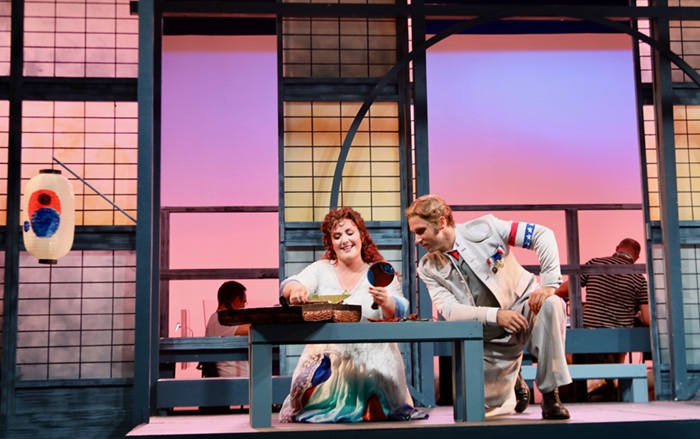
Toni Marie Palmertree as Butterfly (Cio-Cio-San), with Victor Starsky as Pinkerton, in The Princeton Festival’s production of “Madama Butterfly.”
Before a note was sung at The Princeton Festival’s “Madama Butterfly,” the production faced an operatic turn of events: The diva would be able to act the role but could not sing it, prompting a last-minute substitution in which one artist occupied the stage and another sang from the wings. It felt, at first, like a compromise, but it became the emotional heart of the production. By splitting the role, the singers came together in an act of mutual trust and sacrifice to save the show, and their bond felt profoundly moving.
Hours before the curtain rose on opening night, Toni Marie Palmertree — who had been engaged to sing the role of Butterfly (Cio-Cio-San), the heroine of Giacomo Puccini’s famous tragedy — found herself vocally indisposed. At both performances, June 12 and 14, Palmertree acted the role, but Brenna Markey, originally cast as Kate Pinkerton, did the singing, and Aubry Ballaró stepped in to play Kate Pinkerton.
The new production by Eve Summer was the much anticipated continuation of the Puccini cycle that began at the 2025 Festival with “Tosca,” also starring Palmertree in the title role. Victor Starsky, who sang Cavaradossi in 2025, was also invited back and sing F.B Pinkerton opposite Palmertree, who had sung the role of Butterfly at The Metropolitan Opera in March to rave reviews.

PSO STAFF
Toni Marie Palmertree as Butterfly (Cio-Cio-San) in “Madama Butterfly.”
“Butterfly” is well known by many sopranos, but to have a sub jump into the action would have meant getting fitted for costumes and learning all of the technical cues and directions hours before the performance. Even major opera houses and large repertory companies do not always have a robust understudy system in place, and everyone must make the best of a challenging situation.
Performances, which were part of Princeton Symphony Orchestra’s annual summer performing arts series, took place in the outdoor performance pavilion on the grounds of the picturesque Morven Museum & Garden in Princeton, and were conducted by Symphony music director Rossen Milanov. This year’s festival runs through June 21.
“Butterfly,” based on a play by David Belasco, was Puccini’s first exotic opera, set in Nagasaki at the time of its 1904 premiere. It is about a Japanese girl, Butterfly (Cio-Cio-San), and an American military officer, Pinkerton, who marries her, rescinds his promise to return and leaves her downtrodden with a baby. He finally returns three years later with his new American wife, intending to take the baby back to America. Butterfly kills herself rather than be dishonored.
The Far East setting was stylized to just the right degree by scenographer Blair Mielnik. Butterfly’s house was a minimalist façade with sliding panels. Dramatic lighting effects by Paul Kilsdonk created lots of shadow play behind the panels, depicting, for instance, the dusk-to-dawn wait for Pinkerton’s ship, and Butterfly’s death. Neil Fortin’s costumes in white silk with aquatic-colored ombré were inspired by early 19th century Japanese woodcuts. The Americans (and marriage broker Goro) wore stylized separates with hand-painted details including stars and stripes of the American flag.
Japonisme, the 19th-century Western craze for Japanese art and design, was popular at the time of the opera. To modern audiences, the libretto by Luigi Illica and Giuseppe Giacosa can feel outdated for its themes, characterizations and cultural values, and most directors neutralize the more problematic elements, as was tastefully done here.

PSO STAFF
Kayla Nanto, left, as Suzuki, with Toni Marie Palmertree as Butterfly (Cio-Cio-San), in “Madama Butterfly.”
Characters were sharply drawn without lampooning their ethno-racial identities. Religious allusions were glossed over: Butterfly’s maid Suzuki did not pray to Buddha, and Butterfly did not wear a religious cross after denouncing her religion and converting to Pinkerton’s. There were no kimonos or big black Geisha wigs for Butterfly and her friends, nor exaggerated Kabuki costumes as routinely used for Butterfly’s vindictive uncle Bonze, who denounces her for betraying her family and religion. Nan Wang appeared in a simple silk robe and excommunicated her from the family with stern authority.
Goro is often turned into a vitriolic caricature, but Nicholas Nestorak, who sang Spoletta in last year’s “Tosca,” was more decorous and refreshingly unobtrusive. Nestorak is gifted with a unique character voice, cutting and colorful, and used it suavely.
Yamadori, the haughty prince who Goro proposes as Butterfly’s next suitor, was a tenderhearted romantic, plus a good sport, shaking hands with Goro after Butterfly’s rejection. Jacob Hanes, who sang Sciarrone and the Jailer in “Tosca,” made the best of the small role in a towering and tidy baritone. He was so charming and earnest that for once you hoped Butterfly would run away with him.
Milanov was attentive to all the dynamic details: colorful melodies and musical motifs woven into the score. He brought out snippets of the Japanese folk songs, the flower duet’s sweet Viennese qualities and the fugal style of the opening motif. The intermezzo between Act II and III was smartly played in reduction, and still included the bird calls and percussive details. There was also the exquisite, offstage Humming Chorus, sung delicately by the Princeton Festival Opera Chorus, led by Tomás Garcia.

PSO STAFF
Toni Marie Palmertree as Butterfly (Cio-Cio-San), with Victor Starsky as Pinkerton, in “Madama Butterfly.”
With such a small ensemble of musicians, this was not the kind of big, robust shaping that is typical of the work; Milanov took a sprightlier view. In Puccini’s music, fortissimos are rare and Milanov was faithful to this with no excessiveness in the climatic moments. In Act II, for example, when Butterfly has sighted Pinkerton’s ship and realizes that he has returned, the moment is underlined by multiple fortes; here there was an economy of dynamic gestures.
Summer, too, has a keen eye for detail and used symbolism to great effect. In her grand entrance, Butterfly arrived in a garland of white cherry blossoms. At her suicide, a plume of red cherry blossoms rained down on her lifeless body.
Summer’s visionary crack at the final scene leaned into verismo territory. For those who like their operas tied up with a neat bow, the ending did not give closure, shifting the focus to the survivors and the consequences of Butterfly’s final sacrifice. The characters had to witness all the damage Pinkerton had caused without the usual emotional resolution.
In this retelling, after Butterfly’s suicide with her father’s knife, Suzuki entered and ripped away the blindfold from the child’s eyes (which was symbolically fashioned out of an American flag), forcing him to see the aftermath of the selfish choices made by the adults. Then she picked him up and comforted him as Pinkerton and fellow American Sharpless grieved.
Kate — who had first appeared at Butterfly’s house holding a teddy bear, suggesting that she would make a kind surrogate mother to the child — stormed in, wrestled the child from Suzuki’s arms and fled with him. The traumatized child screamed and screamed for Suzuki, setting the final emotional tone. The audience was left to contemplate the future of the child rather than Butterfly’s death and Pinkerton’s sorrow.
In the libretto, Suzuki is loyal and compassionate to Butterfly, but powerless. Here she had more agency and represented the deep humanity that no one else had shown. Kate’s forcible removal of the child created a duality: Was she rescuing the child or kidnapping him from Suzuki, the symbol of Butterfly’s memory? The ambiguity made for a devastating and open-ended finale.

PSO STAFF
Troy C. Jones as Dolore, with Toni Marie Palmertree as Butterfly (Cio-Cio-San), in “Madama Butterfly.”
What at first seemed like questionable characterizations were revealed to be subtle hints. Kayla Nanto’s Suzuki had great warmth and depth in both character and voice. Her flower duet (with Markey) was resilient, with her voice expanding beautifully in the Viennese passage. Throughout, she acted like a surrogate mother to Butterfly’s son Dolore, played by Troy C. Jones. During the emotional letter scene, she entertained him in the background to distract him from hearing the pain in his mother’s voice. She was tough, but not stern, and completely capable of protecting Butterfly: She slapped Goro and sent him running for his life in retribution for spreading rumors about Butterfly’s illegitimate child.
The child was also given some agency. Instead of Butterfly leaving to retrieve him for Sharpless, he appeared on his own accord, seemingly to check on his mother after hearing the distress in her voice of “Ah! m’ha scordata?,” the moment she realizes that Pinkerton has not returned for her.
Pinkerton and Sharpless generally seemed ill at ease. In the first scene, Goro shows Pinkerton the home he will share with Butterfly, and he expresses amusement at the Japanese architecture with its sliding walls. He calls it a “casa a soffietto,” which translates loosely to an accordion-like house. Usually it is said with either whimsy or mockery, but always with laughter in the voice. Here Pinkerton said it ominously, heavy with foreboding.
Though dashing (in a short blond wig by Carissa Thorlakson), he was not much of an arrogant rogue and thrived in the more dramatic moments, including his remorseful aria “Addio fiorito asil!,” which had a beautiful ring and fully shaded tone colors. Joel Balzun’s Sharpless was firmly voiced and expressive. In the letter scene, he was attentive to the lyrical and dramatic weight of all the words.
Palmertree made a sensitive interpreter who moved around the stage unselfconsciously. In the letter scene, she was all open wounds, gasping for air and clutching at Suzuki for support; this was not the wide-eyed, shell-shocked variety of reactions. In Act I, she transformed from coy and sweetly girlish with Pinkerton to fully affectionate. At the marriage commencement, she kissed him on the lips and fell back in a love-drunk swoon that was perfectly timed to the rapturous portamento of the violins in the score.
The sub arrangement generally worked, aside from a couple of moments in the love duet when Markey and Palmertree’s phrasings became a bit mismatched. Markey — who I saw as Pamina in a family-friendly version of Mozart’s “Die Zauberflöte” with New Jersey Symphony and Undead Arts in May — has a full soprano that is lively and expressive with stylistic strengths. Her big aria “Un bel di” grew convincingly from the delicate pianissimo to the dramatic contrasts of the climax, and her farewell aria to her son “Tu? Tu? Piccolo iddio!” had dramatic conviction.
Though there was no emotional resolution to the opera, there was an abundance of it at the curtain call. Palmertree came out for her bow, hand-in-hand with Markey, and the two hugged for a long time. As Markey took her bow, Palmertree struggled to hold back her tears, gradually wiping them away.
“Butterfly” is famously a tearjerker, but this production was deeply emotional for a variety of reasons.
For more on The Princeton Festival, visit princetonsymphony.org/festival.
_________________________________________

CONTRIBUTE TO NJARTS.NET
Since launching in September 2014, NJArts.net, a 501(c)(3) organization, has become one of the most important media outlets for the Garden State arts scene. And it has always offered its content without a subscription fee, or a paywall. Its continued existence depends on support from members of that scene, and the state’s arts lovers. Please consider making a contribution of any amount to NJArts.net via PayPal, or by sending a check made out to NJArts.net to 11 Skytop Terrace, Montclair, NJ 07043.
