


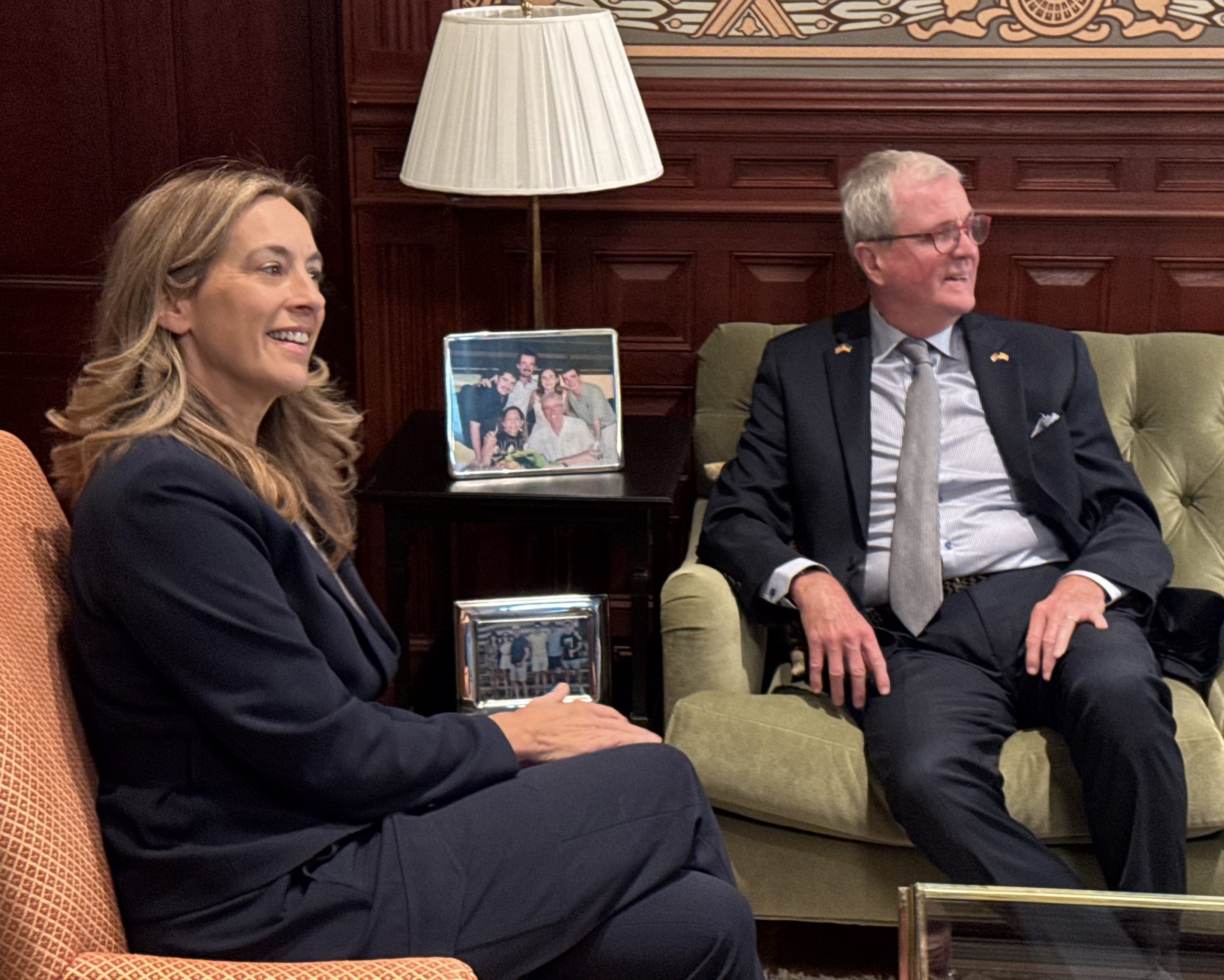
After her resounding, 13-point victory for the governorship on Tuesday, Gov.-elect Mikie Sherrill said she believed New Jerseyans had given her a clear mandate and took the first steps to see it through.
Sherrill met with outgoing Gov. Phil Murphy in his Statehouse office on Wednesday, where they officially began the 77-day transition and discussed staffing strategies. Murphy, meanwhile, has goals of his own during his final months as governor, including the banning of cell phones from K-12 schools and, potentially, a shuffling of New Jersey’s special election laws.
The congresswoman said working-class voters turned to her to guide the state through an affordability crisis and vowed to take aggressive action to address the issues at play. Sherrill described her victories in Gloucester and Morris counties, both of which Republican opponent Jack Ciattarelli won by double digits in 2021, as “seismic.”
“What I saw was that our message was resonating,” Sherrill told reporters after announcing the leaders of her transition team. “Because, I think these working-class communities, whether it’s suburbs in Gloucester, or Black communities or Latino communities, depend so much on good governance.”
When asked which proposals earned her a mandate, Sherrill fired off a long list of issues she’ll tackle upon entering office.
“Expanding the first-time home buyers credit so people can get their foot in the door; taking on landlords who are colluding to drive up rental prices; taking on PBMs, those are the middlemen in drug pricing, to drive down drug costs; addressing the fact that the State Health Benefits Plan is in a death spiral that’s not only raising costs on medical care, but also driving up property tax,” she said, among other proposals.
Many of those proposals, of course, will require buy-in from legislative leaders. Sherrill said she has meetings with Democratic and Republican legislative leaders scheduled for the coming days.
Sherrill also has yet to speak with President Donald Trump, but she promised to immediately work to secure more federal resources for the state and resume funding for the Gateway Tunnel project, which Trump said he’s “terminated.”
Sherrill also offered implicit support for the Immigrant Trust Directive, a state policy that generally bars New Jersey policy officers from cooperating with federal agents on civil immigration enforcement. She stayed mum on the directive during the campaign.
“I’ve focused on keeping people safe here, and I’ve lined that out exactly, how that’ll operate,” she said. “But the Immigrant Trust Directive has a lot of those aspects in it, which I’ve been supportive of.”
Sherrill didn’t say whether she plans to keep New Jersey Attorney General Matt Platkin, who has antagonized many of the state’s major political figures.
“We are building the team out now, and we’ll have announcements coming shortly,” Sherrill said about her prospective cabinet. “But we’re going to hit the ground running, so it should be very soon.”
Sherrill’s promise to declare a state of emergency to freeze utility rates was a central proposal to her campaign, and she made clear on Wednesday that she plans to see it through. Murphy, who earlier this year suggested that such a freeze would be difficult to implement, praised the idea Wednesday.
“I feel badly that I put the cart before the horse when I initially reacted to that. … What I should have said — and I then, for the past couple of months, have been saying — is it’s a great touchstone point to start,” Murphy told reporters Wednesday.
Murphy has his own plans for the next 77 days. The governor said he thinks reform to New Jersey’s special election process could be in the works, which could affect the timing of the campaign to fill Sherrill’s congressional seat.
“On the legislative side, on my list would be bell-to-bell banning of cell phones in school, [it] would be high on that list,” Murphy told reporters. “There’s a collection of housing bills that we’d love to see get through, particularly given how expensive housing has become in New Jersey and the supply-demand imbalance.”
Both state legislative chambers have a handful of sessions scheduled for December.
On the non-legislative side, the governor said he plans to continue retiring medical debt for New Jerseyans as his term ends.
Democrats dominated across the country on Tuesday night. In Virginia, former Rep. Abigail Spanberger won the nation’s only other gubernatorial race by about 15 points. In New York City, state Assemblyman Zohran Mamdani, a democratic socialist, won a heated race for mayor. The diverging paths on display Tuesday — the moderate governor-elects and the leftist mayor-elect — have sparked debate over the future of the Democratic Party after a dismal 2024.
Murphy, who touts his own list of progressive accomplishments in the Garden State, said there is not a one-size-fits-all solution. What works in New Jersey, he said, doesn’t necessarily work in New York City or Virginia.
“There’s a phrase that the Brits use in horse racing, which I’ve always liked: ‘Horses for Courses.’ So you take the horse. If it’s raining, you need a mudder. If it’s sunshine and a fast track, you need a different horse,” the governor said.
Murphy said he reached out to Ciattarelli last night. The governor said he maintains a good relationship with Ciattarelli behind the scenes, even despite their 2021 contest. The governor said he knew Sherrill’s strength and Trump’s unpopularity factored into last night’s results. Still, he feels the congresswoman’s victory was at least partly a vindication of his tenure.
“First of all, I think most importantly, it’s really good for the nine-and-a-half million folks who call New Jersey home,” Murphy said. “Secondly, as a personal matter, given the work we’ve done over the past eight years, that feels good, but these are dire times in our country. We can’t ignore that part, either, and the fact that we need to make statements about who we are as a country, not just who we are as a state. And I think you saw that emphatically last night.”
