


2
AVERY BRUNKUS
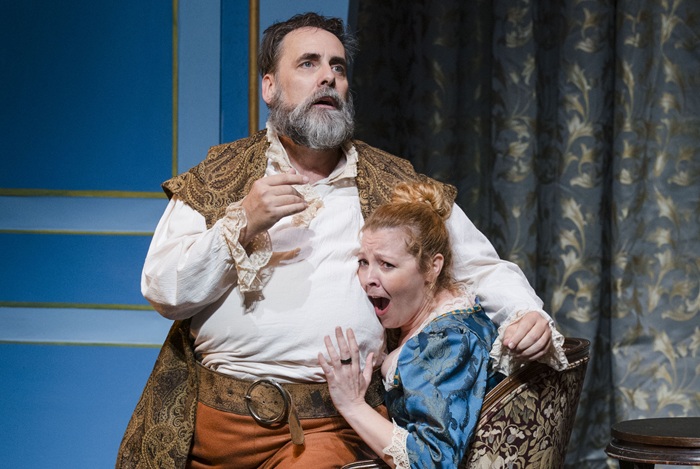
Jeffrey M. Bender and Erin Partin co-star in The Shakespeare Theatre of New Jersey’s production of “The Merry Wives of Windsor.”
The Shakespeare Theatre of New Jersey’s current production of Shakespeare’s comedy “The Merry Wives of Windsor” is presented under the banner of “Rogue Shakespeare” and the following phrase is written on the tickets: “No director. No safety net. Just Shakespeare.”
STNJ artistic director Brian B. Crowe, who also directs many STNJ productions, explained, when introducing the Aug. 16 performance, that in addition to no director being used, rehearsals lasted only six days instead of the usual 3½ weeks. He also said that while the show’s 12 actors had the support of STNJ staff members, they made all the choices in regard to scenery and costumes and so on, themselves.
That’s “how Shakespeare used to do it,” Crowe said.
Did this approach make a huge difference to an audience member? It didn’t seem to me that it did. Yes, the staging was rather minimal, and the production was pretty straightforward — it certainly did not represent the kind of thorough reimagining that an ambitious director might attempt, if inspired to approach a play in that way. But the production as a whole did not fall short of the usual STNJ standards, either.
If you are regular patron of STNJ, don’t be afraid of this “Rogue Shakespeare” and stay away. (But you’ll have to act quickly; the play’s short run ends on Aug. 23.) On the other hand, don’t come expecting something wildly different from what you have seen at STNJ in the past.

AVERY BRUNKUS
From left, David Shih, Patrick Toon and Cole Henry Gilder in “The Merry Wives of Windsor.”
A key factor to the production’s success is that many of the actors — including Jeffrey M. Bender, who plays the main character, Sir John Falstaff — have performed in Shakespeare plays and other works on this stage, many times before. This is Bender’s 28th season with the company. Other actors with nine or more seasons include Michael Stewart Allen, who plays Frank Ford (29); Erin Partin as Alice Ford (17); Patrick Toon as Sir Hugh Evans (14); and Alison Weller as Mistress Quickly and The Host of the Garter Inn (9).
So there is plenty of useful experience here. And while there is no director, the program lists a stage manager (Brielle Morris) and an assistant stage manager (Mikki Monfalcone), plus Bender is credited as troupe leader, and Hassiem Muhammad (who plays Fenton and Robert Shallow) as fight captain. So, obviously, it wasn’t just chaos behind the scenes.
Bender, who has been a standout as classic Shakespearean “fool” characters in many past STNJ productions — as Dogberry in “Much Ado About Nothing” (2014), for instance, and Don Armado in “Love’s Labour’s Lost” (2015) — takes on the role of Falstaff with gusto, wearing an enormous “fat suit” and getting himself into hilariously awkward physical situations as he attempts to win the love of Alice Ford and, simultaneously, Margaret Page (Ka-Ling Cheung).
It is said that Shakespeare wrote “The Merry Wives of Windsor” at the request of Queen Elizabeth I, who had enjoyed the antics of Falstaff in “Henry IV, Part 1,” and asked for a play showing Falstaff in love. If that was really the request … Shakespeare didn’t actually follow it, for it is not love that motivates Falstaff as he attempts to win the affections of the two married women: It is lust and, even more than that, a desire to obtain some of the money that these wealthy women possess.

AVERY BRUNKUS
Emily S. Chang and Hassiem Muhammad in “The Merry Wives of Windsor.”
There is real love elsewhere in the story, though: Frank Ford gets insanely jealous when he learns of Falstaff’s romantic overtures to Alice (unbeknownst to him, she is just playing along to make a fool out of Falstaff). And Anne Page (Emily S. Chang), the daughter of Margaret and George Page (David Shih), loves the earnest Fenton, though Margaret and George have different ideas. George prefers the gangly, ridiculously immature Slender (Cole Henry Gilder), while Margaret sees Dr. Caius, who speaks in a humorously thick French accent, as the perfect match. (Shakespeare also has fun with the heavy accent of Evans, a Welshman.)
Anne’s subplot has a happy ending, and the wives’ plot to thwart Falstaff works perfectly. At one point, he is even thrown into The River Thames. “And as you may know, by my size, I have a kind of alacrity in sinking,” he says.
He accepts the humiliation with a shrug, though, and is invited to feast with everyone else at the end of the play.
There is absurdity and broad humor in virtually every scene, and the actors deliver it all with expert comic timing and infectious enthusiasm. More lofty themes? Not so much. Shakespeare didn’t really bother with them, this time around, and the actors don’t try to make “The Merry Wives of Windsor” into anything more than the trifle he intended.
The question arises: Why doesn’t STNJ do all of its shows this way? (Crowe joked that with this production, he might be “working my way out of a job.”) But I don’t think that is where this is heading.
“Rogue Shakespeare” is just an approach that can work well, with the right material (like “The Merry Wives of Windsor”) and the right group of actors (like this one). I certainly wouldn’t be surprised to see it pop up, maybe once every season or something like that, in the future.
The Shakespeare Theatre of New Jersey will present “The Merry Wives of Windsor” through Aug. 23 at its F.M. Kirby Shakespeare Theatre at Drew University in Madison. Visit shakespearenj.org.
_____________________________

CONTRIBUTE TO NJARTS.NET
Since launching in September 2014, NJArts.net, a 501(c)(3) organization, has become one of the most important media outlets for the Garden State arts scene. And it has always offered its content without a subscription fee, or a paywall. Its continued existence depends on support from members of that scene, and the state’s arts lovers. Please consider making a contribution of any amount to NJArts.net via PayPal, or by sending a check made out to NJArts.net to 11 Skytop Terrace, Montclair, NJ 07043.
