


2
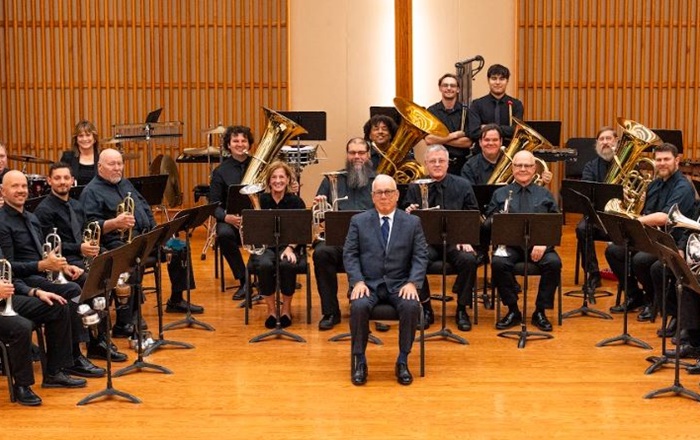
Ronald Waiksnoris, center, and members of Imperial Brass.
An amusing 1900 dispatch from The New York Times reported that farmers in the New York fruit belt discovered an effective way to kill the worms and insects that infested their trees: Hire a brass band to march around the orchard, playing. The report concluded that the vibrations produced by the instruments proved fatal to the pests.
The reputation of the brass band has come a long way in 126 years. A small revolution in the early 1980s sparked great interest and there was no looking back. Ronald Waiksnoris is a notable figure of the movement, which its devotees call “banding.” He is the music director of Imperial Brass, a Westfield-based, British-style brass band founded in 1991 by Rutgers University alumni with the mission to bring great brass music to New Jersey and beyond.

JOSEPH ALESSI
They will wrap their 35th anniversary season July 2 in Ocean Grove with a celebratory concert featuring guest soloist Joseph Alessi, principal trombone of the New York Philharmonic. The program will show off the band’s resonant sound — and the versatility of brass band music — with traditional marches, classical arrangements, and popular music.
The performance is part of the Ocean Grove Camp Meeting Association’s Summer Stars Classical Concert Series, an annual tradition. Concerts take place on Thursday evenings in the Great Auditorium, a massive hall built in 1894 that seats up to 7,000 and features a barrel-vaulted wooden ceiling joined by iron trusses.
The grand acoustic suits this type of brass band spectacular. “It’s a big room, which I love,” Waiksnoris says. “Having 30 brass players, you can play as loud as you want in there, and the sound is okay. In smaller halls, people might be worried about how loud the band is, but not in that beautiful venue.”
The series, which runs through July 23, is free — a new arrangement made possible by OGCMA patrons. Artistic director Gordon Turk, the Auditorium’s organist and artist-in-residence of 53 years, likes to bring in different bands, including symphonic wind bands, and Imperial Brass is a longstanding partner. They last appeared in 2024 with guest artist Mark Ridenour, who was assistant principal trumpet at the Chicago Symphony Orchestra at the time.
Over the years, Imperial Brass has partnered with many of the world’s greatest brass musicians. Alessi, who has played with New York Philharmonic since 1985, is one of them.
“We’ve been very fortunate to have the occasional supporter, financially, which has allowed us to bring in and work with the best performers in the world,” says Waiksnoris. “One of those is Joe Alessi, one of the greatest trombonists out there.”

The cover of the “Bone-A-Fide Brass” album.
The partnership goes back decades: Alessi and Imperial Brass put out a 2007 CD of trombone repertoire titled Bone-A-Fide Brass. It is one of the six CDs that the band has recorded, produced and released since 1995. In Ocean Grove, Alessi will play one of its tracks: “The Green Bee,” a jazz version of Rimsky-Korsakov’s “Flight of the Bumblebee,” a famous orchestral piece from 1900.
It was arranged by Tommy Newsom for dance band, plus a trombone feature written for the American jazz trombonist Urbie Green, who was known for a fluid legato technique and mastery of the instrument’s higher registers. The work is a crowd-pleaser, designed to show off the player’s virtuosity.
Although the trombone is part of the brass family, it does not have valves like the rest of the brass instruments. Instead, sounds are changed by moving a metal slide into seven basic positions. “With valve instruments, things make sense: You put down one and two, and you get a sound,” says Waiksnoris. “But with a trombone, you have to have a pretty good idea of where to place that slide, and it has always fascinated me how they do that — sort of like how the quarterback knows how to throw the ball downfield just the right amount.”
Alessi will kick off the program with Morceau symphonique by Alexandre Guilmant, a French Romantic composer who wrote almost exclusively for the organ. The work is an outlier, written in 1902 for the Paris Conservatoire’s annual trombone class competition. It has become an essential piece of trombone literature, designed to show the full range of the instrument and its expressive, singing tones. “It is a classic trombone solo that every conservatory trombone student probably plays at some point,” says Waiksnoris. “It’s a great showpiece and it establishes the classical style of what Joe can do.”

ROBERT TIEDEMANN
The band will also turn the spotlight on its own talented musicians, including principal trombone Robert Tiedemann, who has been with the group since 2010 and is its president. He and Alessi will play a pop song as a duet. “Their sounds match wonderfully, and the selection shows the beautiful sounds that the trombone can make,” says Waiksnoris.
Percussionist Julian Dippolito will be featured in The Golden Age of the Xylophone, a rousing medley of eight ragtime-themed tunes from the 1900s by Floyd Werle, arranged for brass band by Ralph Pearce.
No brass band performance would be complete without a march, the musical style most associated with them. Imperial Brass will play John Philip Sousa’s 1896 “The Stars and Stripes Forever,” a brass band staple and one of the most popular marches ever written. Waiksnoris says it will be accompanied by the lighting of the Auditorium’s wooden American flag — outfitted with hundreds of red, white and blue light bulbs — that hangs over the historic Hope-Jones/Shaw pipe organ of more than 13,000 pipes. (The Auditorium traditionally lights it up during patriotic concerts and the playing of “The Star-Spangled Banner.”)
To commemorate America250, the band will play works by American composers whom they hold in high regard. One of those is Leroy Anderson, whose light orchestral music mixes classical symphonic forms with popular rhythms and everyday sound effects. One of the band’s co-founders, the late Mark Freeh, wrote numerous brass arrangements of Anderson’s music, some of which can be heard on the 2017 album, An American Legend: Imperial Brass Plays the Music of Leroy Anderson.
In 2022, the Anderson family invited the band to play a concert on the grounds of its historic house museum in Woodbury, Connecticut. Last month, they were invited back to play a concert in celebration of America250. The program, which took place at one of the town’s high schools, included numerous works by Anderson.

RONALD WAIKSNORIS
The July 2 concert will also include the overture from Zampa, an opéra comique by Ferdinand Hérold that has faded from the standard repertoire since its 1831 premiere but is popular in banding. “It is very flashy and fun for the band and great for the audience,” says Waiksnoris.
This is a good example of the traditional banding repertoire from the 19th century: transcriptions of popular works that could be played at venues other than concert halls — outdoors at seaside resorts, for instance.
“In the early days of brass banding, and we’re going back to the late 1800s, most everything was a transcription,” says Waiksnoris. “This is often how people learned classical music. Of course we didn’t have these streaming services like we have now, and brass band was so new that the composers didn’t really know what to do, so they would do a lot of overtures from the operas.”
The unique nature of the brass band repertoire — light in character, slim on masterworks, rich in transcriptions — is primarily aimed at entertainment. The band’s calling cards include works by John Williams, particularly “The Imperial March” from the film “Star Wars: Episode V – The Empire Strikes Back.” On the classical side are pieces by Berlioz, Janáček and Wagner. Waiksnoris says the Russians composers — particularly Tchaikovsky, Mussorgsky and Rimsky-Korsakov — lend themselves very well to brass.
Though the movement was founded by amateur music-makers, the repertory demands great skill. Waiksnoris is also an esteemed cornet soloist, giving him additional insight into banding. “A lot of our guys study orchestral playing or play in wind bands, and brass band is quite different,” he says. “With the brass band, our trumpet players or cornets get to play the violin parts, so it’s very technical, and the approach and the blending has to be a little different. Sometimes, for example, our cornets will have four people playing the same part in unison and that is a tricky thing. But the guys love having that big challenge to play those parts.”

A flyer for the July 2 concert.
The British-style brass band dates to the early 1800s, first emerging during the Napoleonic Wars. It did not hold much interest in America until the early 1980s when it was popularized by J. Perry Watson, the music director at North Carolina State University in Raleigh. “He had gone to England and heard the music and said, ‘We’re going to do this in America,’ ” says Waiksnoris. “So they started the North American Brass Band Association, which is now a huge organization.”
NABBA, formed in 1983, promotes British-style brass banding in North America. Their most important activity is an annual competition. (The competitive spirit is deeply rooted in banding; contests are customary and compulsive.) The 2026 edition, which took place in Fort Wayne, Indiana, in April, drew more than 1,500 performers from almost 50 bands.
The Salvation Army holds a place of significance in the brass band culture. Waiksnoris comes from this tradition: Prior to joining Imperial Brass in 2016, he was the music director of The Salvation Army’s New York Staff Band for 24 years. The NYSB is very active in the worldwide brass scene and goes on frequent tours; Waiksnoris brought a similar approach to Imperial Brass, greatly expanding its reach.
When asked to take over the band, he inquired about their performance schedule and found out there wasn’t much of one. “I said, ‘How can you have a performing group that doesn’t perform?’ So we have gotten much busier. I’m a fan of live music and I think we’ve started performing much more and the band has improved.”
They do roughly 10 events per season. In addition to the Woodbury America250 concert, other notable 2026 appearances included the Gettysburg Brass Band Festival in Pennsylvania; the Mid-Atlantic Brass Band Festival at Rowan University in Glassboro; and joint concerts with Chesapeake Silver Cornet Brass Band in Delaware and the NYSB in Westfield. Additional New Jersey concerts took place in Montclair and Wyckoff.
Waiksnoris is tossing around the idea of an anniversary event in the fall to celebrate former members and milestones, with details to come.
Imperial Brass was founded as The Rutgers Alumni Brass Band by Steve Dillon and Jon Korsun, who were both alumni, and Freeh, the band’s business manager for 25 years and an enthusiastic arranger of brass band literature. After he died in 2017, a scholarship was set up in his memory to support promising brass and percussion students.
The band’s name was changed to Imperial Brass after about a year and a half. “Even though ‘Rutgers’ was a well-known name, the university didn’t endorse the band, so they realized it was a very limiting title,” says Waiksnoris.

Ronald Waiksnoris at an Imperial Brass rehearsal.
They chose the new name based on a hall they had been rehearsing in. “It was called something like The Imperial Club — a social club — so that’s how it got its name and it’s been going strong for 35 years.”
September will mark one year at their new headquarters: The Presbyterian Church in Westfield, which has also been the base of operations for The New Jersey Festival Orchestra for more than 40 years. Music director David Wroe invited them to play at their 2025-26 season-opening concert in September, a first-time partnership between the two. (They played Janáček’s Sinfonietta, padded with extra brass.)
Banding is very popular with music educators; many Imperial Brass members are also school band directors. They come from all over the state, sometimes travelling long distances for rehearsals and concerts.
They are all unpaid volunteers, and costs are met through donor support. They are in it for the enjoyment of the brass band experience. “Everyone is giving their time, and it amazes me how all these guys buckle together and show up, and always commit to doing it,” says Waiksnoris.
Imperial Brass will perform at The Great Auditorium in Ocean Grove, July 2 at 7:30 p.m.; visit oceangrove.org/stars.
For more on Imperial Brass, visit imperialbrass.org.
_____________________________

CONTRIBUTE TO NJARTS.NET
Since launching in September 2014, NJArts.net, a 501(c)(3) organization, has become one of the most important media outlets for the Garden State arts scene. And it has always offered its content without a subscription fee, or a paywall. Its continued existence depends on support from members of that scene, and the state’s arts lovers. Please consider making a contribution of any amount to NJArts.net via PayPal, or by sending a check made out to NJArts.net to 11 Skytop Terrace, Montclair, NJ 07043.
