


4
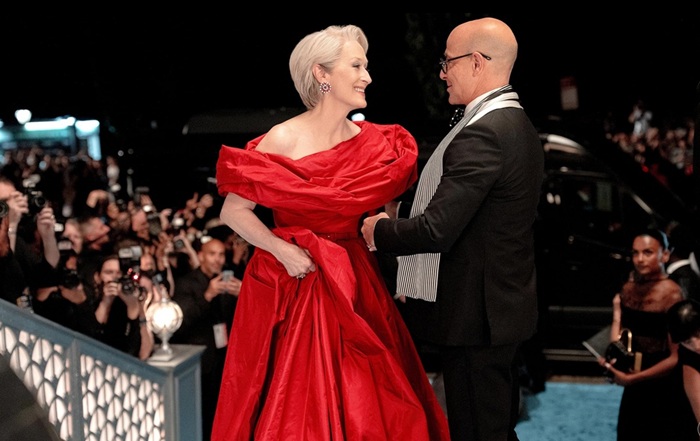
Meryl Streep and Stanley Tucci in “The Devil Wears Prada 2.”
“The Devil Wears Prada 2” opened last week and did very well, grossing $77 million in America. Mother’s Day screenings will surely add more millions.
And the primary, positive lesson there is that if you give women a film with strong female characters, millions of them will come to see it.
Yet it’s a lesson that Hollywood insistently, consistently has refused to learn. Once a year, it seems, studios halfheartedly release one token film with a starry female cast. And every year, when women turn out to support it, the box-office pundits are shocked. Who knew?
Well, they should have.
But “The Devil Wears Prada 2” also speaks to a more complicated issue: Should a work of art reflect its troubled times, or offer an escape from them? “Prada 2” tries to do both. It begins with Andy’s journalism job — her entire outlet — disappearing, even as she is about to accept a top award. It’s a cold moment, and an accurate one — so much so that it made some of the still-employed journalists at recent critics’ screenings audibly uncomfortable.
The specter of sudden unemployment hangs over the rest of the film, too. Even after Andy re-joins Runway magazine, it is buffeted by generational changes in management, editorial course corrections, and takeover bids from bored billionaires.
Yet while that is all rooted in reality — unfortunately — little of it seems very real. Although the laid-off Andy quickly gives a passionate speech about profits, capitalism and the Fourth Estate, worries about her own, sudden, real-life problems — like, severance pay, or COBRA — don’t immediately intrude.
And instead of filling out hundreds of online job applications (only to have them “read” and rejected by AI), Andy almost immediately lands a new, better paying job. She soon celebrates that by moving into a bigger and undoubtedly far more expensive apartment (something I doubt even the most financially reckless journalist would rush to do).

Anne Hathaway in “The Devil Wears Prada 2.”
So yes, there is a bit of reality here. But not too much. And not for long, as we soon plunge right back into the aspirational fantasies of the first film, dropping us into a world of high-gloss parties, ultra-expensive gowns, and summer parties in The Hamptons.
Not every potential audience member was excited by that prospect. “Maybe in this time of poverty, homelessness and billionaires gone awry, we don’t need to see movies like ‘The Devil Wears Prada (2),’ ” was one reader’s response to my review. “Hello?!!!”
I hear you, sir. But maybe if it’s not what we need to see, it’s decidedly what we want. Maybe it’s always what we want to see when things go bad. And that is why, when the real world seems stuck on a downward spiral, Hollywood movies usually put on a happy face. Because optimism is cheap, and pessimism comes at a cost.
Cinema has been there before. As grim as today’s world can be for moviegoers, it is paradise compared to the 1930s.
You think it’s hard to find a job? In 1933, unemployment peaked at just under 25 percent. You feel our social fabric is ripped by racism? In 1935 alone, more than 20 Blacks were lynched in America (and laws against integration and interracial marriage were widespread and unchallenged). Democracy is in crisis? What about a decade dominated by Mussolini, Hitler, Franco and Stalin?
Things were far worse back then, and there were plenty of worrisome stories filmmakers could have told. But what did audiences really crave, and what did filmmakers provide?

Ginger Rogers and Fred Astaire in the 1937 film, “Shall We Dance.”
Fred and Ginger. Screwball comedies. “Little Women.”
Admitted, it took moguls a few years. At first, eager to fill theaters, cash-strapped studios pushed movies that pushed the envelope. Sometimes that meant films that featured more explicit sensuality, language and violence. Sometimes it meant controversial stories, spotlighting contemporary horrors like chain gangs, organized crime, and drugs.
That outraged the bluenoses and eventually the censors came back in force — cracking down not only on sex and gore, but anything that seems to disrespect, or even question, American institutions and authority.
But Americans didn’t complain about this new wave of escapism. In fact, they surrendered to it.
Even as the bad times dragged on, even as a new world war began and thousands of Americans went into battle, audiences still bought into wish fulfillment and happy endings, movies where the starlet always became a star, the monster always died, the sheriff always triumphed and, outside of the deliberate tearjerkers, people always lived blissfully ever after.
Interestingly, it was only after the war ended, and America prospered, that the movies began really questioning things again, with directors like Wilder, Hitchcock and Ford turning out some of their darkest films. Now that audiences could afford a lot more, apparently they could afford some pessimism, too. Cynicism is an expensive vice, particularly when all you have to keep you going is hope.

Emily Blunt in “The Devil Wears Prada 2.”
So it’s not that movies like “The Devil Wears Prada 2” aren’t reading the room. They’re reading the room very well. And the people in that room — in these crowded theaters — are telling them that they are quite aware that they are confronted by poverty, homelessness and billionaires gone awry on a daily basis. And, for two hours at least, they’d like to forget about all of it.
My only concern is that we have ended up in an either/or era. It’s not like the early ’30s, when, occasionally, even studio films like “I Am a Fugitive From a Chain Gang” would take a good, clear look at the real world. Now there is a strict division between relatively inexpensive indie films that seem determined to be downbeat and controversial, and expensive Hollywood films that are practically required to be upbeat and inoffensive.
Admitted, “The Devil Wears Prada 2” works hard to have it both ways. It reflects our times more than most big pictures, for which it deserves some credit. And it gives its fans the catty comebacks and chic costumes they desire, for which it will make hundreds of millions of dollars.
But it also reminds us that while escapism serves a useful purpose, it can’t be all that the big movies offer — just as grim exposes of our damaged society can’t be all that the little ones put on screen. The best films know that, giving us beautiful people (who are somewhat flawed), thrilling stories (that sometimes don’t end less than happily), and made-up-worlds that still resemble life, or something like it.
And provide, not a true escape from reality, but a brief and necessary vacation.
_________________________________________

CONTRIBUTE TO NJARTS.NET
Since launching in September 2014, NJArts.net, a 501(c)(3) organization, has become one of the most important media outlets for the Garden State arts scene. And it has always offered its content without a subscription fee, or a paywall. Its continued existence depends on support from members of that scene, and the state’s arts lovers. Please consider making a contribution of any amount to NJArts.net via PayPal, or by sending a check made out to NJArts.net to 11 Skytop Terrace, Montclair, NJ 07043.
