


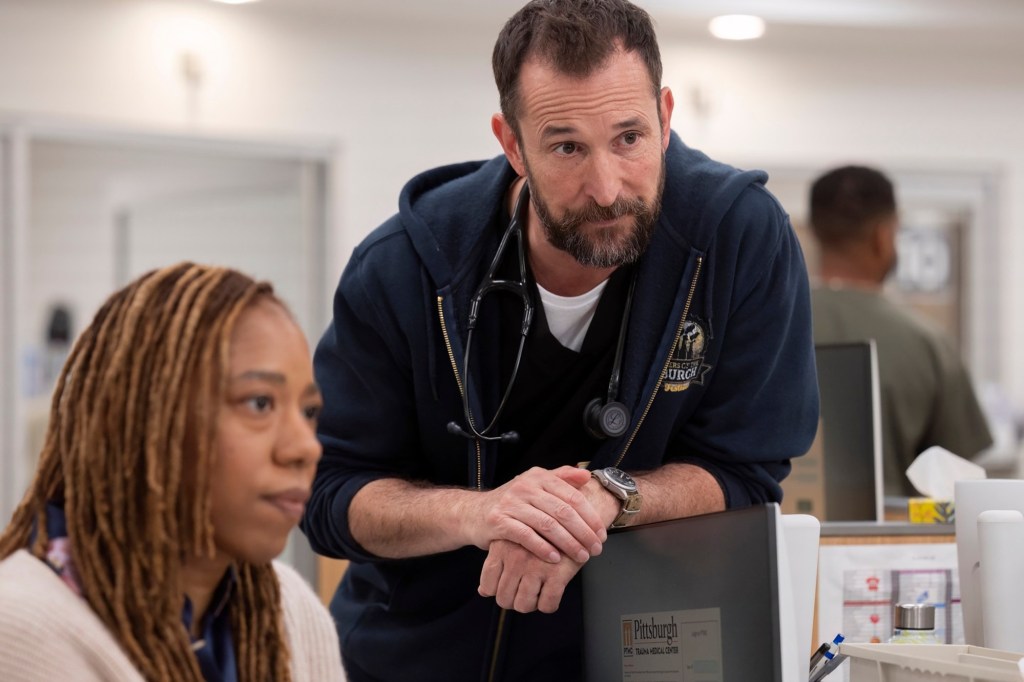
“The Pitt,” a medical drama each episode of which chronicles one hour of a doctor’s life in a busy Pittsburgh hospital, began its second HBO Max season last week.
Both the show and its star, Noah Wyle, known from another medical series, “E.R.,” have justifiably garnered most of the awards for drama and lead actor in the last year.
Once again will have 15 episodes, all taking place, hour by hour starting at 7 a.m. on a July 4 before Wyle’s character, Dr. Robby Robinavitch, is scheduled to being a three-month sabbatical from the Pittsburgh Trauma Center.
“The Pitt” cannot be streamed. It is aired episodically, with a new installment being released each Thursday through April 16.
The episodic release may be a blessing in “The Pitt’s” case considering how intense some of the first season’s individual programs were and how realistically graphic, for instance during an amputation, several of its sequences were.
Another second season, this one separated by a decade, from its debut, begin Jan. 11 when BBC’s “The Night Manager” returns, this time on Prime Video, with its original stars, Tom Hiddleston and Olivia Colman, repeating their roles as the night manager of a Cairo hotel who is recruited by Britain’s Foreign Office to infiltrate a gun-running ring.
Neither Hiddleston nor Colman, though both known, had reached their current levels of stardom when the first round of “The Night Manager” aired in 2016.
Hugh Laurie co-starred during that season as the head of a weapons trafficking operation.
That first season was well-received. It is interesting that it took 10 years to revive the series.
This new skein moves from the Middle East to Colombia, the original setting of John le Carré novel from which “The Night Manager” derives.
“The Night Manager” is not to be confused with an American series, “The Night Agent,” also of high caliber, which has streamed for two seasons on Netflix and has a similar premise with Gabriel Basso playing a U.S. soldier who is relegated to tedious duty in a White House telephone room in which the telephone in question never rings.
Until early morning — 2 a.m.-ish early morning — it does, and Basso’s character, Peter Sutherland, is embroiled in a conspiracy involving a mole in the American government.
Hong Chau co-starred in Season One as a wily White House Chief of Staff who Sutherland cannot always believe but often has to trust.
Fans who remember “The Night Manager” and devotees of “The Night Agent” can watch both over the next couple of months.
The third season of “The Night Agent” begins Feb. 19 on Netflix with all episodes available for streaming on that date.
Jan. 14 marks the second time around for Idris Elba’s series, “Hijack,” on Apple TV, which is emerging as the most interesting streamer going.

This time, Elba’s character, Sam Nelson, must negotiate a hostage situation on Berlin’s U-Bahn, its underground commuter train system, a.k.a. subway.
Like “The Pitt,” “Hijack” is episodic, with new shows released every Wednesday through March 4.
Agatha Christie and London from a century ago are featured in a Netflix series, “Agatha Christie’s Seven Dials,” beginning Jan. 15.
The 1925 setting is important because if someone visits Seven Dials today, they find a posh section northeast of Covent Garden that has seven streets, filled with shops and restaurants that lead to a center point where a monument featuring astrological signs stands.
A century ago, Seven Dials would have been considered seedier, the home of London’s occult, the astrological signs signifying the gathering ground of psychics and others who plied their trade in the area.
The Netflix program, which features Mia McKenna-Bruce as the detective, Lady Bundle Brent, with Martin Freeman and Helena Bonham-Carter in supporting roles.
Also, on Jan. 15, a new Peacock series, “Ponies,” an acronym of sorts meaning “people of no interest,” begins with “White Lotus’” Haley Lu Richardson (Season 2) teaming with Emilia Clarke to play two secretaries working at the U.S. embassy in Moscow, circa 1977 when the Soviet Union existed, and recruited to investigate the mysterious deaths of their husbands.
Another entry for Jan. 15 is the latest “Star Trek” spinoff, the 12th if anyone is counting, “Star Trek: Starfleet Academy,” streaming on Paramount+ and centering on cadets in a training program run by Nahla Ake, played by Holly Hunter.
Robert Picardo is featured as a 900-year-old teacher who appears by hologram.
Jan. 18 introduces “The Knight from the Seven Kingdoms,” the second HBO Max spinoff from “Game of Thrones,” based on George R.R. Martin’s books, “The Tales of Dunk and Egg.”
Dunk, a lowborn knight, is played by Peter Claffey while Dexter Sol Ansell plays his chosen squire with the more august and familiar name of Prince Aegon Targaryen.
Elder Targaryens are played by Finn Bennett and the excellent character actor, Bertie Carvel, who was chilling in a London production I saw of “Rope,” made his name originating the role of Miss Trunchbull in the musical, “Matilda,” and earned a Tony playing Rupert Murdoch in the Broadway production of “Ink.”
The story, part of Martin’s “A Song of Fire and Ice” series, is a prequel to “Game of Thrones.” It is set for six installments which will run episodically each Sunday through Feb. 22.
W. Chester native returns in ‘Clue’
Madeline Raube enjoys playing characters who have a lot of life in them, who may even go a bit over the top in their expressing their enthusiasm and points of view.
Last year, the one-time West Chester resident who relishes the idea of performing before friends and relatives in the Philadelphia area, appeared as the Countess who was in the middle of both controversial political proceedings and the Russian expatriate community in the Paris of 100 years ago, in “Anastasia” at the Miller Theatre.
Next week, she returns as the birdlike socialite, Mrs. Peacock, in a stage version of the 1985 movie and popular board game, “Clue,” at Philadelphia’s Forrest Theatre.
“I like playing characters who are a bit outside of the box,” Raube said by telephone from Ottawa, Ontario, where “Clue” was on tour.
“Mrs. Peacock is the wealthy wife of a U.S. senator. Her costume includes big purple feathers that make her quite visible. I enjoy creating voices for characters, so I chose birdlike sounds for Mrs. Peacock. They fit her attitude.
“It’s important to have your character set and ready to go in a musical like ‘Clue’ because it’s a sprint rather than a marathon. Once we’re onstage, we don’t get off for 90 minutes and are moving nonstop.
“I think of stepping onstage as being like jumping on a moving train. The lights go up, and the cast collectively says, ‘Here we go’ as we go in and out of doors, are part of some mysterious effects, and balance the comedy and mystery inherent in ‘Clue.’ ”
Coming to Philadelphia under the auspices of Ensemble Arts Philly is like moving full circle for “Clue.” It began life in New Hope’s Bucks County Playhouse in 2017 and has been touring or on regional stages since.
It’s book by Sandy Rustin, with additional material by Hunter Foster and Eric Price, is based on the 1985 movie written by Jonathan Lynn.
The famous characters, weapons, and settings from the Hasbro board game figure into the plot.
Foster directed the New Hope production, but since 2020, the show has been helmed by Casey Hushion, who directs the tour occupying the Forrest for one week from Jan. 20 to 25.
“The show has gone through a lot of changes since it was first done. It’s evolved and is different is some ways from what started in Bucks County,” Raube says.
“Casey Hushion has been involved with the show for six years, so she’s an expert in every adjustment and changes. She also knows how to keep everything moving smoothly and how to create that balance between comedy and mystery we talked about.”
Raube auditioned for ‘Clue” in May 2025. She jokes about the process which involved sending two tapes before having live auditions.
“It’s like playing a long game. You go through the steps, and you have your hopes and doubts, but you keep working to be given the part.
“By June, I was cast, and I could see the results of the process. Casey needed to build an ensemble in which all the puzzle pieces fit. You know it worked because everyone in the cast gets along and hangs out together off-stage.”
Raube’s career derives from a combination of experience and training.
“I was born in West Chester and started performing at age 4. Then, we moved to Chicago where I did shows all through junior high and high school. We would return to West Chester to visit family. I have great memories of those time and this area.
“When it came time for college, I went to Oberlin College of Music in Ohio and studied opera. I was pretty sure I wanted to be in musical theater, but I knew that opera would give me a strong vocal foundation, and that was important to me.
“I can’t remember a time when I wasn’t singing. ‘Clue’ is one of the first shows I did that wasn’t a musical. It’s difficult in a way not to be singing, but I make up for it by creating a character voice and giving Mrs. Peacock a distinctive sound.
“Mrs. Peacock is high-strung and always on the point of outrage or hysteria. I have a lot of varied things to do, from being haughty to fainting and dragging bodies. The company is in constant motion. By the time the play ends, I feel as if I’ve done a two-and-a half hour musical.
“But it all feels good, and I love having a juicy character role to play. I also love doing comedy. I have red hair, and I have a special affection for redheaded comedians.
In college, for one of my finals, I did a one-act opera of Lucille Ball. A composer I knew wrote it for one of his school projects. It was great to bring it to life.
“Lucille Ball, Carol Burnett, and Bernadette Peters are my idols and models. Lucy was such a master of timing.
“I look forward to playing some of musical theater’s big comic roles like Adelaide in ‘Guys and Dolls’ and Audrey in ‘Little Shop of Horrors.’
“That sense of comedy and the vocal flexibility from my opera training helps me create the birdlike voice and mannerisms for Mrs. Peacock.
“Another thing about opera training. My voice can be heard in any part of the house. I know how to project without amplification.”
Between “Anastasia” and “Clue,” Raube has spent most of the last two years on the road. She says she likes exploring the country, loves when she comes to Philadelphia because it is one of her homes, and enjoys the weather and natural settings in California.
“One place I’ve never been is Washington, and ‘Clue’ goes there, to the National Theatre, at the end of the month.
“Meanwhile, I can’t wait to see all my family and friends in Philly.”
The amazing ‘Oz’ in the amazing Sphere
Like many people of my generation, I considered it an annual treat when “The Wizard of Oz” would make its annual appearance on television, usually on Thanksgiving during the late 1950s and early 1960s.
It was an event to finish dinner at my maternal grandparents’ house and sit with my siblings and cousins, not to mention all of the adults, to see this amazing fantasy.
I became an “Oz” aficionado, reading all of the L. Frank Baum books and wearing people out telling them the differences between the written stories and the movie script. Adults liked it. Other children looked at me with that “when is he going to shut up?” glare.
I have never lost my fascination and admiration for the 1939 movie. I still kvell when I remember how I got to see Judy Garland in concert in Atlantic City — by passing Convention Hall and asking my grandfather if “Dorothy was in that building” — and by sheer accident taking Margaret Hamilton’s arm to walk her down an icy Philadelphia street.
I was just being a Boy Scout and offering a hand until Miss Hamilton and I started talking and I realized who she was.
Since its first television appearance, I have seen “The Wizard of Oz” on all kinds of screens and in several edited versions, including some that include the “Jitterbug” scene that was cut from the movie.
Twice this fall, I got to see it in amazing fidelity and with the right kind of interactivity at the Sphere in Las Vegas. The Sphere is a huge theater. It can seat thousands.

Both times, I sat in the center towards the rear of the theater (Section 405), so the entire panorama of spectacle was visible to me.
The screen and the images projected on it are large, the characters take on a lifelike cast. During the hurricane, the seats shakes. When its rains and snows, both fall in the Sphere’s theater.
When the tree throws apples, apples are tossed to the Sphere crowd. Winkies fly in front of the screen as they fly on it.
The fidelity of the Sphere’s engineering shows the simplicity of painted backgrounds, including the Emerald City and the witch’s castle, but that is made up by the opulence of Munchkinland and other scenes.
I found myself getting into the plot the way I did when I was a child and became more attuned to the wit in the script.
Go to Vegas, go to the Sphere and see “The Wizard of Oz” in a way that delights this fan. Stay after the movie to see Oz created before you in the lobby.
