


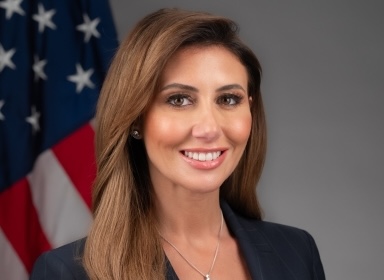
After the Third Circuit Court of Appeals ruled last week that she had been unlawfully appointed to the role, Alina Habba announced today that she will resign from her contested post as acting U.S. Attorney for the District of New Jersey.
“As a result of the Third Circuit’s ruling, and to protect the stability and integrity of the office which I love, I have decided to step down in my role as the U.S. Attorney for the District of New Jersey,” Habba, a close Trump ally, said in a statement. “But do not mistake compliance for surrender. This decision will not weaken the Justice Department and it will not weaken me.”
Habba’s appointment had been the subject of a lengthy battle between President Donald Trump’s administration, which took a series of extraordinary steps to keep Habba in office beyond the expiration of her original term, and federal judges who continually halted their efforts. In her resignation announcement, Habba accused those judges of becoming “weapons for the politicized left,” and blamed New Jersey Senators Cory Booker and Andy Kim for blocking her nomination in the Senate.
Habba’s departure leaves the post of New Jersey’s top prosecutor vacant – and, because she was concurrently serving as the First Assistant U.S. Attorney, the typical order of succession in the office is in severe flux. The Justice Department said today it was naming three new officials in the U.S. Attorney’s office, each of whom will supposedly have the authority to supervise different divisions: Philip Lamparello, who was named senior counsel with authority over the Criminal and Special Prosecutions Divisions, Jordan Fox, named special attorney with authority over the Civil and Appellate Divisions, and Ari Fontecchio, named Executive Assistant U.S. Attorney with authority over the Administrative Division.
Habba said that she will remain at the Department of Justice as “the Senior Advisor to the Attorney General for U.S. Attorneys.”
She also said that she will “wait for further review of the courts [sic] ruling,” though it’s not immediately clear what review she is referring to. The Trump administration has the option to appeal the Third Circuit’s ruling to the U.S. Supreme Court, but it has not yet done so, perhaps in an effort to avoid an unfavorable precedent being set if the high court rules against them.
Attorney General Pam Bondi, who doggedly defended Habba’s appointment throughout the months-long battle, similarly blamed the outcome on “politicized judges” and referenced a “further review” of the case that has yet to be reflected in any court filings.
“The Department of Justice will seek further review of this decision, and we are confident it will be reversed,” Bondi said in a statement. “Alina intends to return to lead the U.S. Attorney’s Office for the District of New Jersey if this occurs.”
A former member of Trump’s personal legal team, Habba was named interim U.S. Attorney in March, just a few weeks after Trump had named a lesser-known attorney, John Giordano, to the role. As interim U.S. Attorney, Habba was limited to 120 days in office (or less, if Giordano’s brief tenure is counted as part of hers); in July, with her term expiring and the Senate taking no action to approve her nomination, New Jersey’s District Court judges stepped in and chose Desiree Grace, the office’s First Assistant U.S. Attorney, as her replacement.
But the Trump administration, unwilling to allow Habba’s ouster, fired Grace and named Habba as the new First Assistant, which elevated her to the acting U.S. Attorney’s post by default. The series of maneuvers was entirely unprecedented – and, according to several New Jersey defendants who sued in federal court, entirely illegal.
In August, District Court Judge Matthew Brann ruled in favor of the defendants, determining that federal law regarding U.S. Attorney vacancies constrains presidential administrations from taking several of the actions that Trump’s Justice Department took to keep Habba in office. Brann stayed his own ruling pending appeal, keeping Habba in limbo for a few months more, but a three-judge Third Circuit panel unanimously affirmed Brann’s ruling on December 1, firmly disqualifying Habba from office.
Habba’s contested appointment was the first, but not the only, front in the Trump administration’s battle with both the Senate and the judiciary over U.S. Attorney posts. In the wake of Brann’s initial ruling, acting U.S. Attorney appointments in Nevada, California, and Virginia were all ruled to be unlawful under similar logic.
Though it wasn’t at the core of the legal fight over her office, Habba’s appointment was also newsworthy simply because of Habba’s own unusually politicized conduct. Shortly after being named to the post, Habba said she hoped her actions could help “turn New Jersey red,” and her highest-profile case revolved around prosecuting Democratic congresswoman LaMonica McIver for allegedly assaulting ICE officers during a detention center oversight visit.
With Habba now out, the Trump administration once again faces the prospect of naming someone to fill the U.S. Attorney spot, and it has several ways to go about doing so: continue picking nominees who will get blocked in the Senate by Kim and Booker, precipitating another potential legal battle, or work with the senators to choose someone who can win Senate confirmation.
This is a developing story and has been continually updated.
