


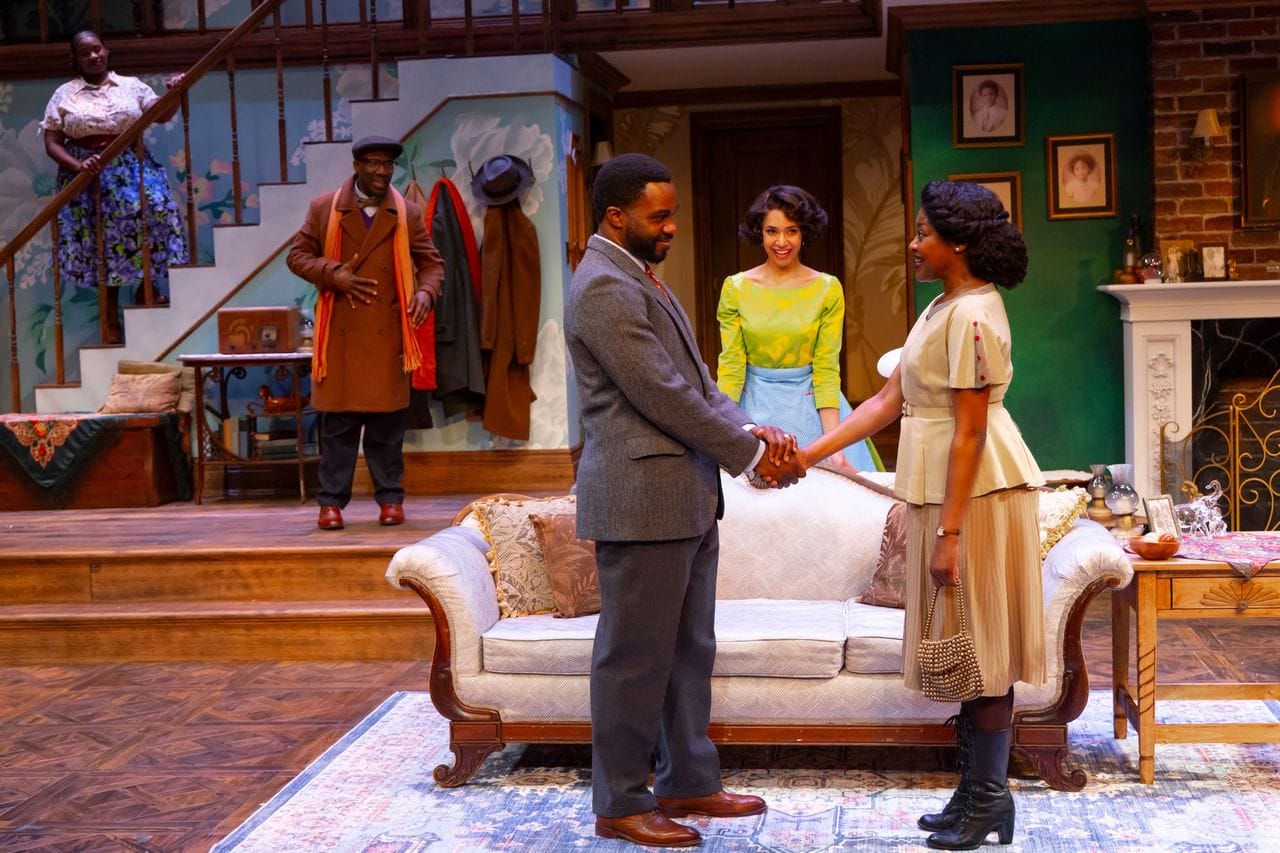
When Henrik Ibsen penned A Doll’s House in 1879, its groundbreaking themes of female identity, patriarchy and marital norms shocked audiences. Today, the themes of his classic work remain strikingly relevant.
At Two River Theater in Red Bank, director and Jersey native Justin Emeka reimagines Ibsen’s play as a 1950s-era drama unfolding in suburban New Jersey, trading its Victorian setting for a mid-century, middle-class home. His revisioning and direction illustrate how social mores at work in 1950s New Jersey, in some ways, mirror the pressures of social standing, belief systems and gender roles of the late 1800s.
A Doll’s House is the story of Nora Helmer, a housewife with no financial independence, as dictated by the laws and social mores of the time. In her independent spirit, however, she goes behind her husband’s back to secure a loan. Nora’s character—and indeed, all the women of her time—are infantilized, and making such a decision without her husband’s consent is illegal and sacrilegious, even if done for a selfless reason. The repercussions of that decision play out in dramatic fashion, capturing problematic limiting beliefs about women and the confining roles those limits place on both sexes.

Photo: T. Charles Erickson
For this interpretation, a primarily Black cast steps into the classic roles, amplifying the play’s reach with new tensions while continuing to tap the universal themes of personal agency, gender and the sometimes suffocating, invisible hand of society.
Emeka layers nuances drawn from the Black experience, touching on civil rights, redlining and domestic expectations to deepen this rendition while upholding its original impact. The play’s structure adheres to the traditional unfolding, while adaptations—such as Nora’s character being biracial and her husband, Torvald, being a Guyanese man—are integrated seamlessly.

A Doll’s House is filled with the comically giddy, gasping, sighing, dancing and prancing Nora Helmer, whom audiences have related to, sympathized with and cringed at—for evolving reasons—for more than a century. Photo: T. Charles Erickson
A biracial identity affords Nora a historical financial leg up, while her and Torvald’s respective races place restrictions on their opportunities for upward mobility. Torvald, additionally, as a Caribbean man, wrestles with his own set of societal ambitions and restrictions.
Other departures from the original script include morphing the housekeeper role into that of a family member, Helen, a promising classical cellist who lends a winning soundtrack to the dramatic romp.
The two-and-a-half-hour production unfolds with its timeless conflicts—revenge, blackmail, acts of courage and cowardice—which crescendo in an ending that’s nearly as surprising for a 1950s setting as it was in the 19th century. It leaves the audience to ponder questions that time has not eradicated: Where is the line between bravery and blasphemy by society’s standards? What is worth fighting for, worth saving? And who gets to decide?
A Doll’s House is on view at Two River Theater in Red Bank through March 15.

The Rooster and Scrubs star moved to Malibu 35 years ago, but still has a hankering for a Millburn Deli sandwich.

The 22-year-old Rutgers grad and Paramus native says he’s “in it to be in it” on this season of “Idol.”

Josh Crandall of the Clever Commute app offers advice for getting into Manhattan during NJ Transit’s suspension of direct trains to Penn Station this month.

Which local restaurants are your tried-and-true favorites? Fill out our annual poll for the chance to win dinner for two.
