


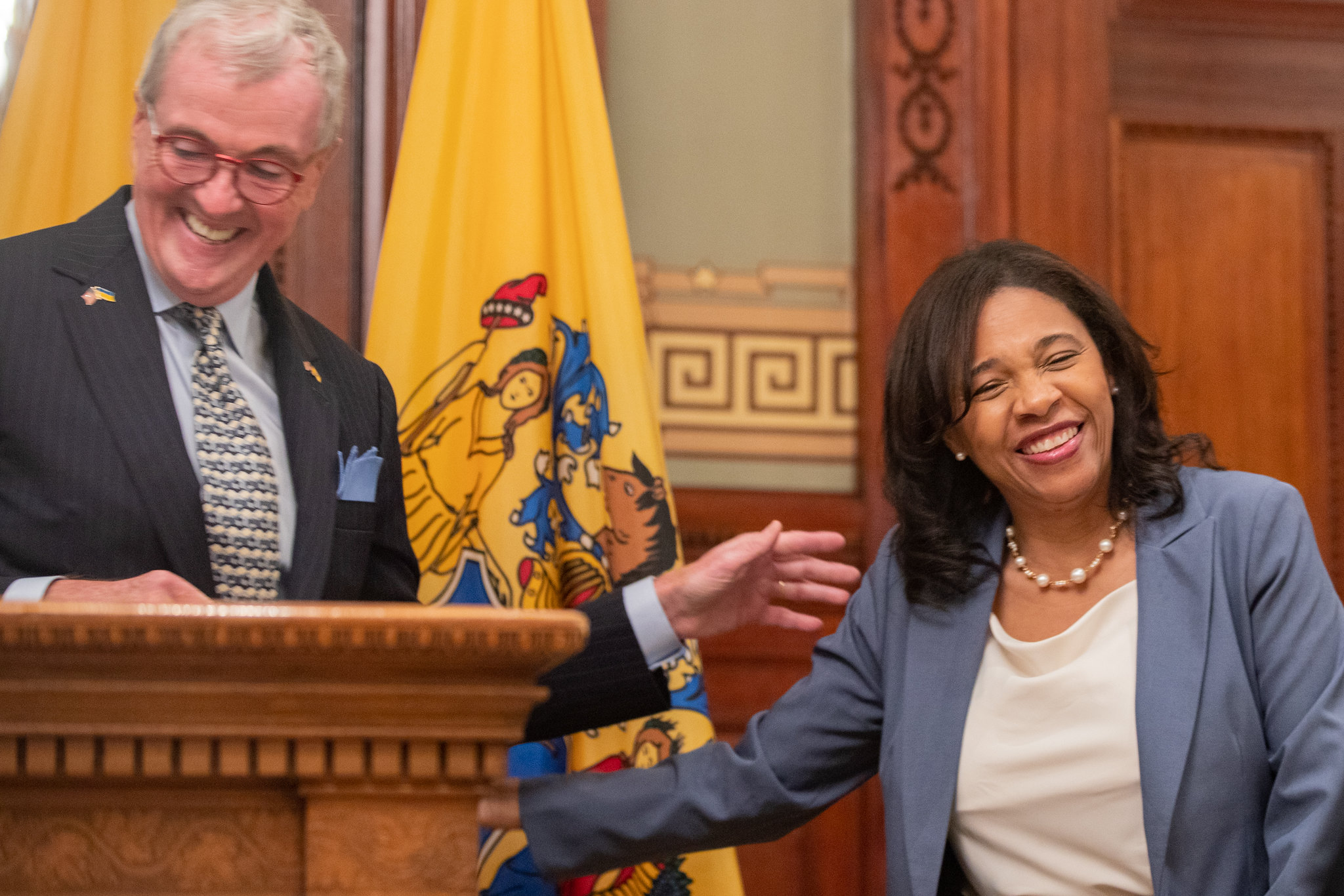
The New Jersey Globe conducted an exit interview with Lt. Governor Tahesha Way on January 16, four days before her term expired. Here is a full transcipt of the interview, edited slightly for brevity:
David Wildstein:
What do you view as your legacy as the lieutenant governor?
Tahesha Way:
I see my legacy as lieutenant governor as being able to put people — and their voices, their opportunities — first, on both sides. I serve as Secretary of State. By way of the Constitution, [the lieutenant governor has] to oversee a cabinet agency. And when I think about where we have come since 2018 in New Jersey, we not only modernized our elections, we made them more secure. And of course, we expanded the right to vote.
Wildstein
Any regrets about taking this job? I mean, I know it was under awful circumstances that you were offered this.
Way:
Very much so.
Wildstein:
But you got offered this opportunity. Are you glad you took it?
Way:
This is one of the most distinct honors of my lifetime, David, besides becoming a mom of four. I have always taken all of my positions seriously because the full faith in our elected officials is really about authentically serving our 9.5 million residents. And again, getting back to our democracy, which is the floor to all opportunities, it has been a wonderful, and I should say blessed, experience being able to ensure that there are free, fair elections.
But at the same time, the work that I’ve done as lieutenant governor, I look at the various laws that I have implemented as acting governor — I think between executive orders and legislation, there’s about 40 of them. As a mom, I always take the mental health and overall health of our kids to heart. So signing that expansion of the Madison Holleran [Suicide Prevention] Act, where now college students have more of the resources that they so need, in light of what occurred to Madison Holleran, is significant and important. Being there to partner alongside Governor Murphy with the expansion of universal pre-K, which is significant and important. Making sure that there’s more seats in our state, over 20,000 have been created during this administration. For me, it’s just been an overall privilege. So there has never been a single regret. The people of New Jersey are just the best people you would want to serve, and no regrets here for me.
Wildstein:
So Tuesday afternoon, if you need to go somewhere, you’re gonna have to drive yourself. You’re gonna lose your detail. Are you going to miss that? Are you going to miss being able to get where you have to go in a quick amount of time?
Way:
Will I miss it? I will actually miss those who served on the detail, because they do become like family, dear friends to you. But at the same time, I’m one who’s always appreciated the private nature, and I’ve only called upon the detail when needed. I think that the public needs to recognize the reason why we have the protection is throughout my tenure, there have been threats made. I’ve stood strong, myself and my team, just making sure that the electorate knew that they should not be in fear to vote. So that’s why you have that, the detail around you, just making sure of that. But still, when you’re in the vehicle, you’re working, you’re responding to constituents’ concerns. You’re doing the public work 24/7.
Wildstein:
So this job, secretary of state, goes back to the origins of state government and the very start of the nation. But the lieutenant governorship is fairly new. Now that you’ve gotten to be in this job, one of three people, was the Legislature right in creating this job? Was this the right move not just by the Legislature but by the voters who approved it?
Way:
I believe it, 100%. I’m thankful that the state Legislature came to that point, because the majority of our states have lieutenant governors, those second-in-commands, so that if emergencies happen, if a governor is out of state conducting the good business of the people, that’s where your lieutenant governor can step up. Our governor has been doing the good work for the people out of state, traveling on business, doing economic delegations, bringing some good jobs back. And during those times, there have been those acts of nature in which you would have to have someone such as myself declaring the state of emergencies. For me, I really was always laser-focused on ensuring the safety needs of our New Jerseyans.
Wildstein:
I want to go back to a point that I think is a defining moment of your career, which is you get a call and you’re told: “We’re in the middle of a global pandemic. It’s not safe for millions of voters to come to the polls in person. And guess what, Madam Secretary, you’re in charge of creating the first all vote-by-mail election in New Jersey history, and we’re only going to give you a couple months to implement it.” Tell me about that experience.
Way:
Initially, when we posited that we were going to pivot this way, there were naysayers. There were naysayers [who said it] could not get accomplished, especially because things were getting shut down, necessarily so, and you just have to think about the infrastructure changes. So the one thing that I’ve always done, David, is make certain that myself, my team, are always connected with other states and how they, too, conduct their elections. I was always engaged in the National Association of Secretaries of State. A year or so later, I became president, and I was the first New Jersey secretary of state to do that in 119 years. But that’s neither here nor there.
But the point is, by establishing the relationships and understanding how other states were not only conducting their elections by way of mail, but also they are able to shore up their systems, which is key. So we were able to call my counterparts in Washington and Colorado, because the one thing that I always wanted to establish with our voters is the understanding that we’re going to conduct elections in a nonpartisan, fair way. I never wanted anyone to question integrity here. So we decided to choose Washington because at that time, a Republican secretary was leading it, and then we chose Colorado because a Democrat was leading it. And that’s when we developed and got their best practices. I still remember those 6 a.m. calls. I’ve always rolled up my sleeves, and even throughout the night, during the times when there were some legal challenges to us perfecting vote-by-mail, curing ballots, and putting out the secure ballot drop boxes.
But we also had to make certain that there was enough PPE. We needed to get our bench together in terms of poll workers. It was challenging at that time, but I must credit how our local election officials really rose up to this. They, too, were on the phone and at meetings 24/7. None of us were going to let this deter us. And then when you just think about how we, in 2020, went from 400,000 voters who at that time were the vote by mailers, but now we have over 1 million voters who took to this. Even if there’s a challenge or a negative moment in time, there’s always going to be this silver lining, right? It showed who we are and what we can accomplish in such a short [period] of time. We even had to educate the public. It wasn’t just about infrastructure. My team and I had to gather up coalitions of folks, ensuring that they too could reach their constituents and give an education to the public on vote, sign, seal, return.
Wildstein:
It’s never been easier to vote now, right? Vote-by-mail has picked up considerably. It looked like in 2024 and 2025, New Jerseyans really took to early voting. You, Governor Murphy, the Legislature, you’ve all [made] it easier for people to vote. And that’s what democracy is based on, I think, is people being able to turn out.
Way:
Yes. I even look at what we’re celebrating this year, which I’ve led, in partnership with others: the semiquincentennial — I always make the joke that Governor Murphy, when he was interviewing me for secretary of state, asked if I could pronounce it. And when I did, I said to him, “semiquincentennial,” and he said, “You’re secretary.” But I mentioned the semiquincentennial because I know everyone did not have the franchise then, but it’s important that we look at these principles of equity, of justice, of self-determination, of voice, and that’s exactly what we ultimately wanted to accomplish here in terms of our democracy, in terms of our elections. And the legacy is there. I love now that when I walk up to voters who are the VBMers, they compliment that they can track their ballot too. I love hearing how folk can, online, not just register, but verify. I love the fact that, in terms of informing and educating voters, we created vote.nj.gov, which streamlines the process. Because I always say to our electorate, I’m thankful that you vote, but I do want you to be an informed voter.
Wildstein:
Do you worry that with the decline of the media, voters are becoming increasingly less informed about how the government operates and when elections are?
Way:
Well, that’s why my team and I doubled down on vote.nj.gov and making sure that through our voter-education channel, social media, not only will the electorate learn of specific dates, but we always want to counter any disinformation that may be out there. And the hope is that these ways of communication that had been laid at the Division of Elections, Office of the Secretary of State, will still be hitting the ground.
Wildstein:
When it comes to voting rights, what is it that keeps you up at night in terms of what we’re looking at down the road in terms of elections, not just in New Jersey, but nationally, being secure and fair?
Way:
The one thing that I really had appreciated up to a certain moment in time was the way that we were able to to work on all levels of government authentically to ensure that, not only on a state level, that there is that genuine focus on the federal level of the cybersecurity of infrastructure, because you want to make certain that your voters have true confidence in your system and in your election official. So there may be more of a decline in partnership with the federal government and resources and supporting our counties. Because I look back at the 2025 election, and I know that we were experiencing the early morning bomb threats. Thankfully, they were not credible. But I look at years in the past where we had more of the federal partnership and focusing on resources instead of just saying “We’re going to send monitors to various counties.” It had been a strong collaboration throughout the years. I even remember that we had various tabletop exercises in which we had those federal partners that were genuinely trying to be there on New Jersey’s side.
Wildstein:
I know a lot of your colleagues at the National Association of Secretaries of State are elected by the voters. Did New Jersey’s modern-day Founding Fathers get it right when they said, “We’re not electing the Secretary of State, the governor will appoint, the Senate will confirm.”
Way:
Well, I really am not going to comment with a broad brush. I don’t think that any of this is a cookie-cutter approach, because for me, if you know one state, you know one state. But what I will say is that I’ve prided myself on being that secretary of state who understood that I should just present elections, conduct those in a free and fair manner, because the last thing that I ever wanted, David, was for anyone to ever have any credible reason right to question myself, my colleagues at the Division of Elections, Office of the Secretary of State, and even our partners in the municipal and county level, because ultimately, that would be a disservice to our voters. It has brought so much joy to my heart when you go and speak to voters, and they do say and corroborate, “Well, you know what? We do know that your elections have been run free and fairly.”
Wildstein:
One of the things you said — it’s always a trigger to me — I say a lot, “If you’ve seen one judge, you’ve seen one judge.” Now that you’ve had this experience as the chief election official, what does Jersey do about election laws being interpreted so many different ways, depending upon what judge hears it, or which county board of elections hears it. Is there a fix for that? Do you have any advice for fixing it going forward?
Way:
My advice, I defer. I respect the state legislature. I have always, from day one, like with any laws, I’ve always said we want to have an eye on Title 19. And especially given the changes that we have in our elections, right? We’ve implemented so many different laws, which is a good thing, but we always just want to make certain that the laws comport to modern-day times.
Wildstein:
I cover you almost exclusively on election matters, but I don’t want to diminish the role that you play in working with the state’s businesses and helping them grow, and working with the arts community. What are you most proud of in those areas?
Way:
I always see the Department of State is one of the smallest departments in the cabinet, but I do say that we are the mightiest. I look at travel and tourism, what we have done; the highest visitor spend on record, which was, I think, last year, $50 billion. Every year, David, visitation has increased by 7% on average every year, but for the COVID years. We look at the arts, right? Arts is a creative economy, and we’ve done so much, and I credit my Council on the Arts as to what they’ve done, especially in making sure that post-COVID, the arts and artists organizations have been lifted up. Creative economy, that’s about 25,000 jobs per year. And then I look at small businesses, how they’ve been uplifted, especially through our exporting unit, bringing in the most federal dollars every year in comparison to every state. And the Business Action Center, which is a very, very important area of our business sector. I know we always speak about Choose, we speak about EDA, but the Business Action Center is really where the small business owners can get those resources and support that they very much need.
And I know I signed a matchmaker law, and that’s where our Business Action Center comes into play too. But I can’t forget about all of the mighty cultural commissions that the Department of State has, like the Israel commission, the Martin Luther King Jr. commission. So it’s one of the mightiest departments that anyone can lead, because there are so many different portfolios. I know that I had the idea of the Black Heritage Trail, which was codified into law. The semiquincentennial and all that other good stuff. But again, to the lieutenant governor side, I’ve also had the pleasure of focusing on wealth disparity, economic opportunity, and government transparency and public trust; signing the financial transparency law, which is key.
Wildstein:
One of the worst-kept secrets in Trenton is that you’re a little bit of a history nerd, and State Museum falls under that. Do you ever go, just get lost, like your staff didn’t know where you were, and all of a sudden, they find out that the lieutenant governor, sitting in the basement of the State Museum, that you found a box that was really interesting?
Way:
Yeah, I just hope that through archives showcasing the 250th in tandem with the museum, all New Jerseyans will witness the beauty that the museum has. My favorite place in the museum was always, and will always be, the dinosaur exhibit.
Wildstein:
There’s sort of a tradition in government of leaving a letter on your desk when you walk out for the last time for your successor. What are you going to tell Reverend Caldwell when he walks into the office for the first time? What’s he going to hear from Tahesha Way?
Way:
I actually have left two letters. One was for the Secretary of State, and one was the Lieutenant Governor. I won’t get into the specifics of it, but the one thing I know is these are two privileged and blessed jobs that one must carry in their hands. And I would just leave it as that.
