


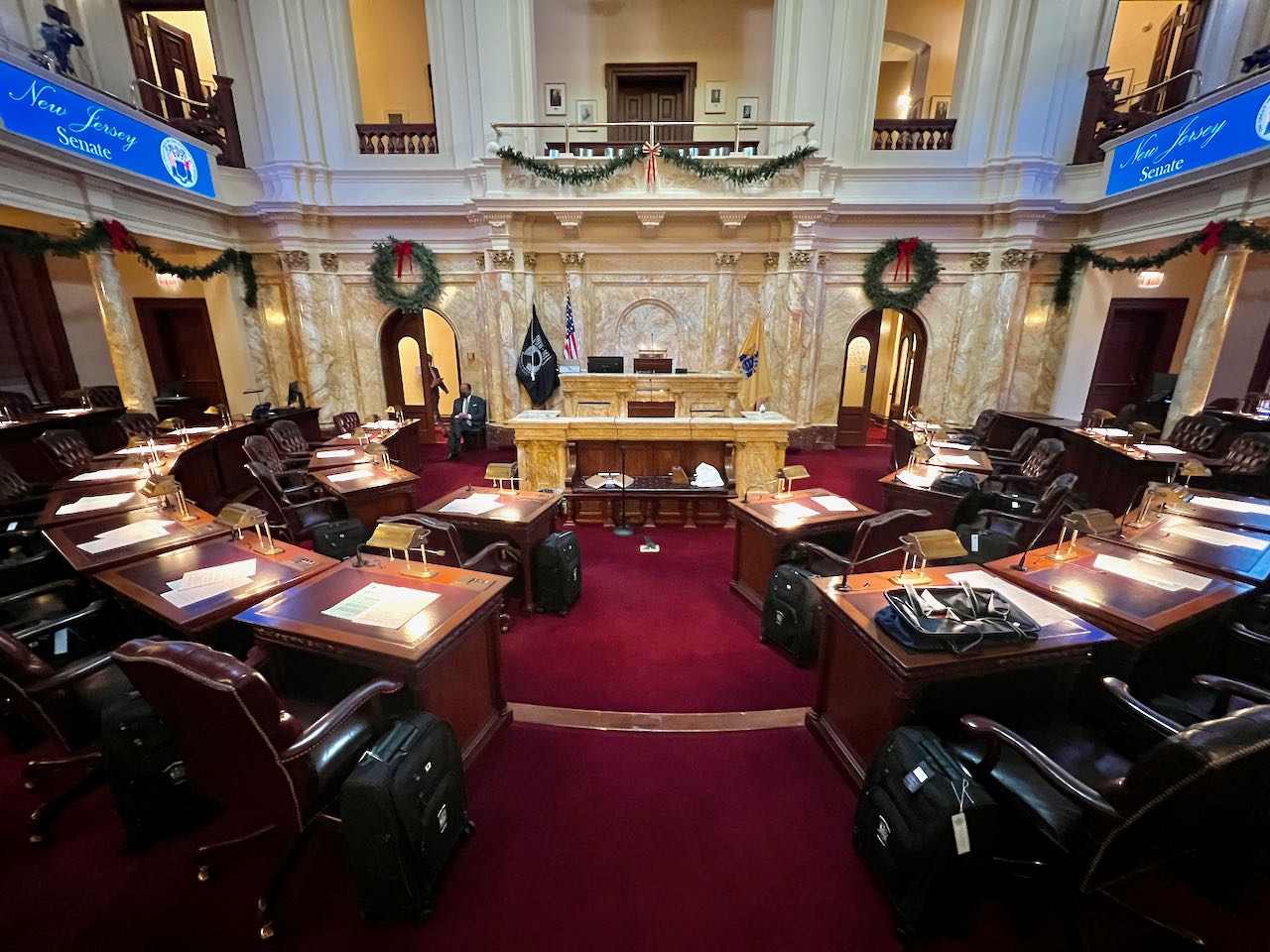
The New Jersey Senate on Monday quietly adopted sweeping rule changes that tighten its control over gubernatorial nominations — closing loopholes that let governors rely on long-term “acting” appointments without ever submitting those officials for Senate confirmation.
Under the change, when a governor installs someone as an “acting” commissioner, director, or authority head in a job that generally requires Senate confirmation, the governor now has 90 days to formally nominate that person. If no nomination is submitted within that window, the Senate President may send a formal message to the Governor declaring the acting appointment rejected and the acting official legally barred from continuing to serve.
This is a consequential shift: for decades, governors of both parties have relied on acting appointments — sometimes for years — to avoid contentious confirmation fights or circumvent senatorial courtesy.
Gov. Phil Murphy appointed Latrecia Littles-Floyd as acting chair and chief administrator of the state Motor Vehicle Commission in July 2022, but never formally nominated her. Littles-Floyd became increasingly fearful of questions from senators over long lines at the agency and the lack of appointments to get a Real ID. She spent 3 ½ years in an acting capacity to avoid the confirmation process.
Under the new rule, a committee rejection automatically becomes a full Senate rejection — no floor vote required if the Senate meets at least once after the committee vote, if the Senate President formally accepts the committee’s recommendation, or if no Senator immediately objects by moving for an advice and consent vote. Before the rule change, a committee rejection was merely advisory.
Another change resolves an odd procedural ambiguity dating back to the 1970s.
Under the revised rule, any nomination that receives fewer than 21 ‘yes’ votes is automatically rejected — even if the number of “no” votes is also below 21.
This codifies the Senate’s handling of a 1972 vote on Gov. William Cahill’s controversial nomination of Dr. Carl Marburger as Commissioner of Education. Marburger had been nominated to a five-year term by Democratic Gov. Richard Hughes; Cahill, a Republican, reappointed him in 1972 despite the opposition of the New Jersey Education Association.
The Senate vote to confirm Marburger was deadlocked at 19-19; the split—12 Republicans and 7 Democrats—was the same on both sides. Cahill determined that Marburger should resign. This was the first time under the current State Constitution that the Senate rejected a cabinet choice on the floor.
The new rule makes the standard explicit: 21 votes are required to confirm; anything less is a rejection.
The changes don’t affect a nominee serving in an acting capacity and awaiting Senate confirmation.
The Senate also tightened the process that follows a rejected nominee. When a nominee is rejected — either by vote or by the new committee mechanism — the Senate President must notify the Governor stating that the nominee is legally prohibited from serving or continuing to serve in their post. In another shift, rejected nominees may not be resubmitted during the same two-year session unless the Senate President personally authorizes reconsideration. If the Governor tries to reappoint them anyway, the Secretary of the Senate must immediately return the nomination.
In 2012, the Senate Judiciary Committee rejected Gov. Chris Christie’s nominations of Phil Kwon and Bruce Harris for seats on the New Jersey Supreme Court. Senate President Steve Sweeney declined to advance them to the full Senate, and their appointments were effectively declared dead.
After Gov. Robert Meyner renominated Attorney General Grover Richman for another term, Richman couldn’t get through the Judiciary, and Meyner pulled him.
In October 2020, Murphy nominated Angelica Allen-McMillan to serve as Commissioner of Education, but she was initially unable to secure Senate confirmation.
Under the unwritten rule of senatorial courtesy, Allen-McMillan received signoffs from Essex in 2021, after which she would presumably have been confirmed with little issue.
But the day before she was due to appear, the New Jersey Globe reported that she had recently moved from Montclair to Cedar Grove, which is part of the 40th legislative district; that gave Republican State Sen. Kristin Corrado (R-Totowa) courtesy over Allen-McMillan. Corrado had not been informed of the move until the Globe told her, and said the acting commissioner’s lack of honesty led her to hold up her nomination.
With a new legislature taking office on January 9, 2022, Murphy would have had to nominate Allen-McMillan for a third time. He had resubmitted her nomination to the Senate in January 2022.
