


The basics:
- Panel explores disruption, AI integration and mental health in leadership
- Speakers discussed vulnerability, work-life balance and stress management
- Leaders emphasized evolving workplace culture and shifting expectations
- Panelists shared personal experiences shaping their leadership journeys
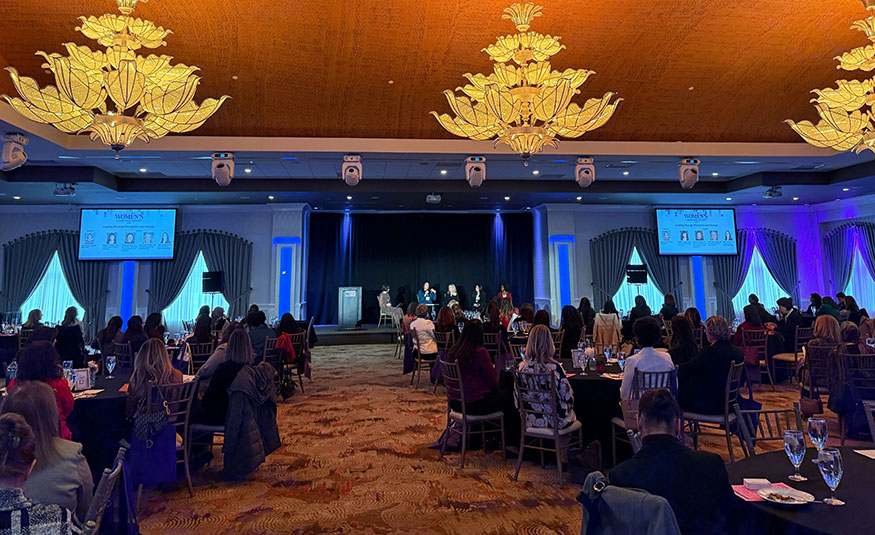
Critical issues for the journey of women leaders were hit on during a panel at the 2025 NJBIZ Women’s Leadership Summit.
The speakers explored navigating disruption; integrating AI; supporting mental health; and balancing leadership, work-life harmony and stress management.
The discussion, moderated by NJBIZ Managing Editor Jessica Perry, featured:
“It’s interesting because there’s a saying – that the only constant in life is change,” Perry said at the outset. “But despite that, when change happens, it can be intimidating. It can be disruptive. It can also prevent opportunity. So, today, we have a wonderful panel of speakers who are going to help us navigate and work through these topics.”
Over about an hour, the lively and informative discussion weaved through a number of these themes as the panelists shared their own experiences and how it shaped their respective journeys.
Taking the lead
A particularly enlightening part of the panel came as things shifted to adapting to culture changes.
“You spoke about coming into the role and building your own team – just thinking about being a leader, in general, and the changes that we’ve seen in the workforce and the culture you guys are talking about creating,” said Perry. “Maybe you can comment a little on – do you feel that leadership expectations have changed? Mental health and well-being and the visibility of it more so than anything else – these are topics that, as the culture changes, how does that change?
“What do you feel you need to do as a leader and how you’re leading?”
Visibility gains
“I think leadership has changed in that I see a lot more women leaders – and I love that,” said Mulligan, who noted that she was part of a group that includes women in construction, architecture, planning and engineering – in a lot of roles that weren’t typically filled by women; and how her field is dominated by men. “And I’m so proud to be a part of that and to really learn from these women. But I think one of the big things that is a misconception about leadership, is what you said – vulnerability.
“And being in that discomfort, and sometimes sitting in that discomfort is where you find the solutions, where you find the way through,” Mulligan continued. “And mental health right now – I think as I have a person that works for me is a working mom. I have two kids and two step kids, and life is crazy. I think about, as a leader – embrace vulnerability. Vulnerability isn’t a bad thing. We’re all human. We’re all being affected by things that are going on in the world in different ways.
Vulnerability is not a weakness – and it can be a superpower.
— Courtney Mulligan, Russo Development
“I always think, I don’t know what everybody has going on. Someone could be dealing with caregiving for an elderly parent or going through a divorce. I’ve been through one myself when I was much younger, and I thought I had to be like, I’m fine, and then I would go in the bathroom and talk to my lawyer and cry. Vulnerability is not a weakness – and it can be a superpower.”

Bouncing back
Roth went next, “I don’t think this is really a news flash, but it’s not just women who are vulnerable, not just women who are emotional. And I think it’s really no longer about that. It’s not 100% – still have a long way to go, but I think that it’s important that we realize that we are where we are because of who we are. Part of that is being a woman. It’s not in spite of being a woman. I’m also in a more male-dominated field, and it has been since I since I started.
“But I don’t let that be who I am or why I am. I think I am who I am and where I am and why I am – because of me. And the things that we develop ourselves, and the confidence and the capabilities and all those things that maybe we could do better because we’re women, because maybe we’re juggling more. I always tell this story.
Be prepared

During the 2025 NJBIZ Women’s Leadership Summit, a panel of experts from Flagstar Bank, Faith Health Group, Firefly Financial and OnePoint BFG Wealth Partners also shared tips on budgeting, retirement planning and building long-term confidence for women as they hit peak earning and caregiving years. Read more here.
“We’re always trying to keep the balls in the air, all the balls in the air. In reality, sometimes the ball is going to drop. And it’s up to us to make sure that it’s the rubber ball that drops and not the crystal ball. It’s all about prioritizing. It’s all about setting ourselves on that path to make sure that the crystal ball doesn’t drop. At different points in our life, at different points in our career, it’s different things that are the priority,” Roth continued, talking about different periods in life and the different priorities.
“We all have to be whether it’s reaching a goal, whatever that thing is, that’s the priority, the one thing that if it drops, it’s going to break, and it’s going to have the biggest consequence, that’s where you have to focus, and you have to be okay with the rubber ball dropping, because maybe that’s going to create a different opportunity.”
Trust exercise
“Just because we wear it well, doesn’t mean it isn’t heavy. And I say that a lot to a lot of my employees,” said Wolfman, noting that she is a single mom of three and her oldest just left for college and how she feels like she blinked and her daughter was through high school. “I personally, as a woman and as somebody that wears 7,000 hats, I do feel like there were times in my career that I had to do everything by myself. Because in my mind, I was like, if I don’t do it myself, it’s not going to be done the way I want it done. If it’s not done the way I want it done, then we’re just going to have to redo it. So maybe as well just do it by myself.
“But I had to really learn to drop a lot of those rubber balls, or one at a time, or some of those rubber balls to make sure that I don’t blink, and that she graduated college,” she continued, or missing other activities for her other children; and noting the family-first culture at her company that stresses taking care of things that need to be taken care of at home. “So, to be able to entrust, like you said before, within our teams, to throw that ball and say, I need you to do this. Here’s how I need it done. Here’s how I would like it done, please just follow up with me after. And just that consistent follow up of trusting in your team to throw those balls.”

New views
“We work for a mental health care agency, and I worked hard for years to get here. Was a single mom at one point – my mom lived with me for five years recently. Work, work, work. I had a strong support system for help, but it was work, work, work. So almost every year, I gave back PTO. I lost it because I didn’t take it,” said Johnson, noting the contrast in how things were previously done and how women often looked at this subject – and how things are evolving.
Johnson said that her company this year has instituted personal wellness days – realizing that people need a break. Even while at work, she emphasizes going to take a walk outside, get a coffee, and/or taking a lunch break.
“This year, for the first time, I think I used all my PTO time,” she said – adding that she told her team that the expectation from her leadership was to use their time and take a mental break. “And I do try to lead by example. But I grew up in this industry where the woman had to prove; had to do, even though we were single parents, etc.
“I think this generation is demanding something different.”
