


 Listen to this article
The basics:
- NJBIZ panel explores energy costs, infrastructure and innovation in NJ
- Experts cited grid constraints, AI demand and renewable project backlogs
- Panelists discussed efficiency upgrades, clean energy programs and C-PACE
- AI’s role in managing energy demand and predictive maintenance is growing
As part of NJBIZ’s latest virtual discussion, panelists spoke about current trends and issues relating to energy, infrastructure and innovation in New Jersey.
Moderated by NJBIZ Editor Jeffrey Kanige, the Oct. 28 program featured:
- William Heller, of counsel at Newark-headquartered law firm Genova Burns LLC
- Tiffany Lewis, outreach manager for TRC Cos. Inc., a global consulting, engineering and construction management firm specializing in environmentally focused, digitally powered solutions
- Laurie Weigand-Jackson, president and CEO of Utility Advantage, a Woodstown-based energy consulting and services firm
- Matthew Fazelpoor, energy and infrastructure reporter at NJBIZ
During the 90-minute roundtable discussion, panelists addressed the significant energy rate hikes New Jersey consumers have experienced this year and how to offset those cost increases, using AI to optimize energy efficiency, demand and maintenance, and protecting critical energy infrastructure from cyber threats.

In June, New Jersey consumers saw significant energy rate hikes, with residential electricity bills rising between 17% and 20%, or roughly $22 to $28 more per month for an average household.
The increases were largely driven by higher wholesale and capacity costs in PJM Interconnection LLC’s regional power market and a supply that is outpaced by demand. To ease the impact, state regulators approved a temporary $60 summer bill credit and extended protections against shut offs for low-income and vulnerable customers.
On the campaign trail
Fazelpoor described it as a “prominent issue” in the Nov. 4 gubernational election between Democrat Mikie Sherrill and Republican Jack Ciattarelli.
“In other campaigns, energy’s mentioned, but not always. Property taxes and affordability in New Jersey is always top of mind,” he said. “If not the top issue right now, it is one of the top two, three issues in the state that’s being discussed everywhere.”
“It hits into all the other things going on – cost of living, health insurance, mortgage rates, everything,” he said. “And just the timing of it hitting June 1 right before summer, it definitely made an impact.”
Replay: Energy, Infrastructure & Innovation
Click through to register to watch the full panel discussion!
Weigand-Jackson said, “I think what the business community is dealing with right now is just trying to understand why? And are we going to see this for the next couple of years? Is this just a one-off? I think from our perspective, this is going to be for a couple of years.”
Weigand-Jackson went on to explain that recent electricity price hikes and supply constraints stem largely from issues between PJM and Federal Energy Regulatory Commission. For years, the back-and-forth over how to run capacity auctions disrupted the usual three-year planning cycle, making it hard for power generators and developers – both fossil fuel and renewable – to plan new projects, she said.
Not an overnight fix
As a result, generation hasn’t kept pace with rising demand driven by data centers, AI and cryptocurrency. She also blames PJM’s backlog of unprocessed renewable projects, higher natural gas prices, and outdated federal rules that kept some clean-energy projects out of the market — all of which have combined to tighten supply and push prices higher.
“There’s a lot happening in the market that over the past five or six years led to this point. So, it wasn’t as if one thing caused it, and it’s not something that’s going to get fixed overnight. But fundamentally, the issues relate to the fact that we do not have enough supply to meet demand,” she said.

She went on to say, “The grid absolutely needs to be modernized. Our grid is this grid that we’ve had a hundred-plus years … And we have been investing in upgrades to the grid, but not specifically to support where this new generating assets would be coming online per se. And that’s why PJM has this really long queue of projects because what they’re doing is assessing the impact on the transmission system. It is tied together – both transmission and generation – but we don’t know what the transmission upgrades are until PJM does their analysis.”
“They’re the ones that are responsible for this. They manage and operate that power grid from Illinois to Jersey to West Virginia. This massive grid – the biggest in the country is operated by PJM – and they’re the ones that have to do these analyses, approve transmission projects or submit them up. And then FERC [Federal Energy Regulatory Commission] also gets involved because it’s interstate commerce. So, there is a combination of the need for transmission upgrades, but where do we upgrade the transmission system? Well, we have to know where the generation is going to be.”
Surge of support
Lewis said, “All of the utility companies throughout the state are really investing to support customers with decreasing their energy use. So, they’re putting more teams out there in terms of engagement and community engagement and doing outreach to really connect with the customers and ensure that even underserved communities and UEZ [Urban Enterprise Zone] zones are receiving that additional support so that they can help fund projects that will help decrease their utility bills.”
“There are individuals where their utility bills are a significant portion of their expenses … there’s a sector of our state here that is really struggling with these high energy costs and I’m appreciating what is happening right now to try to alleviate some of that specifically for our most affected consumers,” Weigand-Jackson said.

Lewis went on to encourage all rate payers – whether they are homeowners, renters or businesses – to connect with utility companies to learn about the range of available resources, such as energy audits and financing support, to fund energy efficient upgrades.
She also pointed out that the New Jersey Board of Public Utilities is actively investing in clean energy programs by offering funding and credits for municipalities and commercial facilities that look to add technology or undertake projects to save energy and strengthen resilience.
“Part of the goal is to decrease the customer’s energy use so that we can decrease that demand on the grid to support with less power outages and these issues while the utilities are still upgrading their infrastructure because they have a long way to go,” said Lewis, who works with JCP&L (FirstEnergy company Jersey Central Power & Light) through her role at TRC.
Getting energized
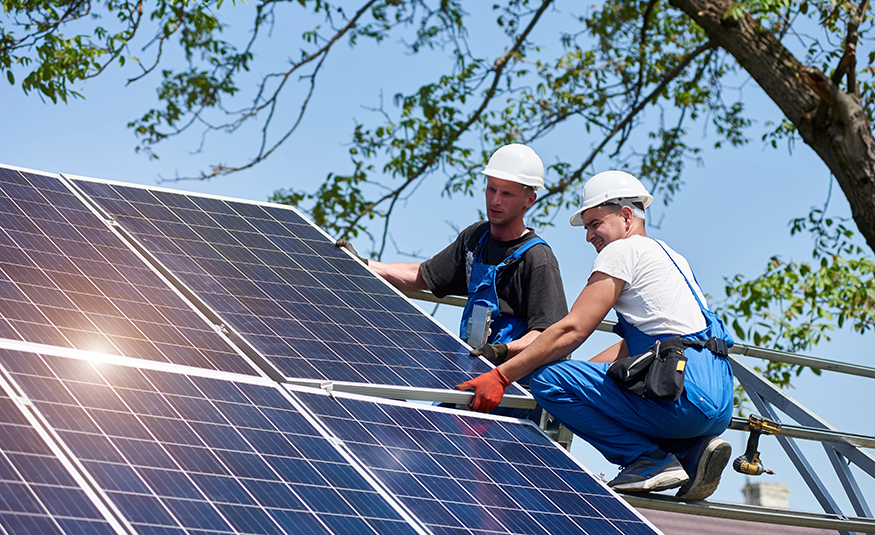
While offshore wind development in New Jersey remains at a standstill, panelists spoke about growing adoption of solar power across the state in recent years. For example, Heller, a former senior vice president and general counsel of the New York Giants NFL team, noted that when NRG became a sponsor of MetLife Stadium about a decade ago, it added a ring of 1,350 solar panels on the roof of the East Rutherford property.
Because New Jersey lacks large open land for massive solar farms, the state’s focus is on smaller distributed energy projects placed strategically where the grid can support them, according to Weigand-Jackson.
She emphasized the need to improve energy efficiency and expanded distributed resources, like solar, battery storage and demand management, as a way to reduce consumption and costs. “I do think the solution is more distributed energy solutions and not large-scale plants,” Weigand-Jackson added.

As for public-private partnerships to help spur development of such systems, Fazelpoor said he hasn’t heard of much happening in that area.
“And even if a company were going to make an investment right now, the timeline is many, many years out,” he said. “Given that the problem is already at our doorstep and likely to grow with the demand of data centers and AI, it’s all kind of colliding with those factors in place.”
And, with energy becoming such a political issue in New Jersey, he believes that will make it “even harder to get anything done right now.”
Data center demands
Additionally, participants reflected on the issue of data centers.
In New Jersey, development and construction of facilities involved in AI operations and cloud computing is typically focused in the central and southern parts of the state. But the massive amounts of electricity and cooling required for the sites has led to local concerns. Much of the opposition centers on how that high-energy demand can strain the grid and raise electricity prices. Environmental impacts, like noise, water use and land consumption, have also been flagged.
Weigand-Jackson said data centers should fund their own energy generation or infrastructure upgrades rather than passing those costs to all ratepayers.
“We can absolutely require them to do that. We can develop rate structures specifically for data centers. We can put policies in place that is something the state can control,” she said, noting that Ohio recently began regulating such sites more closely after rapid growth in the industry.
As of July, Ohio’s utilities commission requires large data centers to pay for at least 85% of their subscribed electricity capacity, even if they use less, to prevent higher costs for other customers. Regulators also created a special tariff class for data centers and ended a temporary moratorium on new connections once those rules were in place.
At the same time, the Buckeye State continues to offer tax incentives to attract data center development, such as sales tax exemptions for major investments, while managing its grid impacts.
‘The time is now’
Panelists also agreed that how energy is used and managed is key.
Lewis explained that an important step for ratepayers right now revolves around energy management, such as upgrading systems and optimizing equipment to reduce peak energy use. Utilities are also offering incentives and training for businesses and contractors to help meet energy-saving goals while batter storage and distributed energy are still being developed.
Lewis continued, “There are funds available … the time is now. Please reach out and there is a wealth of resources and support available.”

One such resource is the Garden State Commercial Property Assessed Clean Energy (C-PACE) Program. Through the state-run initiative, commercial, industrial, agricultural and certain nonprofit owners can receive financing toward clean energy, water conservation and resiliency improvements.
Through C-PACE, power consumers can access long-term, low-interest financing for improvements such as solar panels, HVAC upgrades or flood protection, and repay the loan through a special assessment on their property tax bill. The financing stays with the property, not the owner, if it’s sold.
After the New Jersey Economic Development Authority approved the offering in October 2024, it began accepting project applications this past summer.
However, for property owners to use the program, municipalities must opt into it. As of August 2025, only six of the state’s 564 towns are active participants – Hackensack, Lakewood, New Brunswick, Oldmans Township, Plainfield and Woodbridge.
Weigand-Jackson said, “If you think this is something that would be good for your business, go talk to your municipality and ask them where they’re at … They probably all have heard about it, but they may not know enough or think that the demand is even there to go through the process of becoming a C-PACE municipality. But it is a financing mechanism that’s been operating all around the country successfully and ultimately is now here.”

‘Incremental steps’
“For a lot of business owners, they say, ‘Yeah, OK, that sounds great, but I don’t have the capital to replace this equipment right now. And if I’m going to put the money in, I’m going to put it into the main purpose of my business and not upgrading my heating or cooling or lighting or refrigeration equipment.’ But now we have either 0% or very low percent financing on your utility bill. It’s never been easier for businesses to take advantage of both the incentives and the financing. Energy efficiency is definitely something every business that’s listening should be looking at,” Weigand-Jackson added.
“Take a look at your utility bills, try to understand them, reach out to professionals who can help you understand them and start looking at energy as a manageable expense. It isn’t something you just have to take. You can actually do things to manage those costs,” she said, adding, “I would encourage people to be looking at energy efficiency and renewable energy. They’re cost-effective solutions and they are not too expensive, they’re viable today.
“Maybe 10, 15 years ago, things like solar were expensive. Now, it’s very commercially available. Very cost-effective. Battery storage? Not quite yet. But we will get there. That doesn’t mean don’t do battery storage — it just means that the cost is going to come down over time. So, it’s really a financial decision on your part at this point. But these are the things that you can do to help yourself at these times of volatile and rising energy costs,” Weigand-Jackson said.
“I think it’s even a better approach to talk to people about incremental steps. It’s important to have goals, I get that, but we need to be realistic. We don’t know how long it takes for technology to evolve and so I think it’s better to have the shorter-term ones of what we can do in the next three to five years and then keep working toward something,” she said.
AI-powered
The use of AI to manage energy is only increasing. According to business consulting firm Grand View Research, the global market is expected to rise from about $11 billion in 2024 to nearly $55 billion by 2030, as more adopt AI for grid management, forecasting and efficiency.
Driven by the need for cost reduction, greater efficiency and clean energy integration, utility and energy firms are using the tech for grid optimization, predictive maintenance and demand forecasting.
Just some of the tasks that AI is tapped for include: predicting energy demand so utilities can balance supply; optimizing building systems to use less energy automatically; detecting inefficiencies or equipment problems to prevent energy loss; and coordinating renewable sources, such as wind and solar, by forecasting output and adjusting usage.
The energy industry is also focused on collaborating with tech companies, like Microsoft, and research institutions, such as the Electric Power Research Institute, to scale AI, share data, develop models and modernize the grid for reliability and decarbonization.
Heller stressed the need for caution with AI.
“It is a tool and it’s a good tool, but it cannot be the sole tool because it generates the wrong information,” he said. “Many, many people are affected by the adoption of an AI-generated solution.
“And one of the issues that I face as a lawyer doing contracts in this field is whether a corporation relying on AI has insurance coverage to almost analogous to legal malpractice insurance to enable the use of AI, but to protect the business against the risks of overreliance on AI,” he said.
