


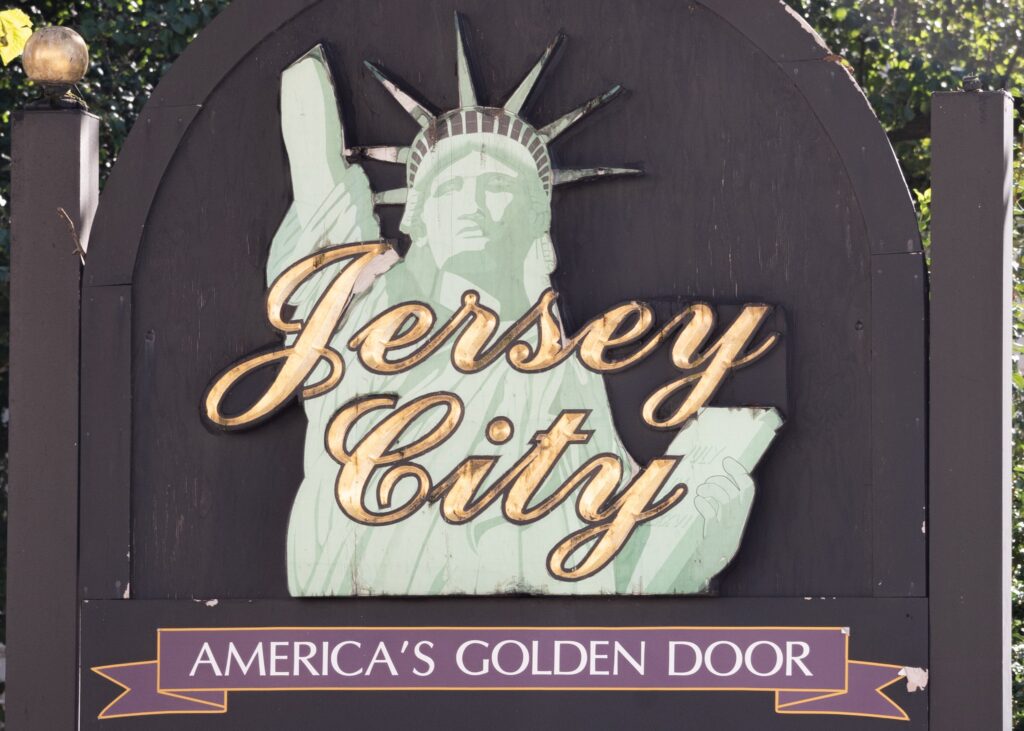
Steve Fulop is stepping down as Jersey City mayor after his failed bid for governor. Seven are vying to succeed him. (Photo by Fran Baltzer for New Jersey Monitor)
With most political observers in New Jersey focused on the gubernatorial election, Jersey City is seeing its most competitive mayor’s race in more than 20 years.
The stakes are high for the voters here, New Jersey’s second-largest city and perhaps its most ethnically diverse and economically buzzing municipality. Seven people are competing to succeed Mayor Steve Fulop, a Democrat who is stepping down after three terms, with his potential successors promoting themselves as the most capable to keep attracting new people to the city while making sure that rent and other costs of living don’t force longtime residents out.
The front-runners in the nonpartisan race are Jim McGreevey, a former governor; Bill O’Dea, a Hudson County commissioner and former city councilman; and James Solomon, a city councilman who represents the city’s waterfront and downtown areas. They are joined on the ballot by Mussab Ali, a former school board president; Christina Freeman, a city police officer; Kalki Jayne-Rose, a musician; and Joyce Watterman, the president of the city council.
Voters will likely wake up the morning after Election Day with another campaign ahead. If none of the candidates garners more than 50 percent on Tuesday, the top two vote-getters will go head-to-head in a Dec. 2 runoff.
The governor’s race has focused largely on concerns that New Jersey has become unaffordable. The same issue is also at the center of the campaign in Jersey City, where critics have said for years that the city’s leadership is too interested in promoting luxury housing at the expense of longtime residents who worry about being priced out.

O’Dea believes that the city needs to grow using a mix of small, medium, and large real estate projects in order to expand housing options while keeping costs down. He has also criticized city leadership for not enforcing rent control laws already on the books.
“My cell phone blows up with text messages and calls on a daily basis of people that are being evicted. People don’t know how they’re going to pay their rent,” said O’Dea, 66, who also serves as the executive director of the Elizabeth Development Company. “Until recently, the city wasn’t enforcing the rent registration law. Anybody who’s part of the municipal government shares the blame for that.”
Solomon has decried what he called a “luxury-only” model of housing development over the course of Fulop’s mayoralty, leading to extraordinary profits for developers. He added that he would strive to cap rent increases and aggressively enforce rent control.
“We’re going to make sure that if developers build, they’re building for the whole community, not just for a small part of it,” said Solomon, 41. “If you’re in a unit that already has rent protections, we’re not going to let landlords and developers push you out so they can make greater profit.”

McGreevey said in Jersey City, “We build buildings, not communities.”
“To deal with affordability, it’s a combination of factors like controlling spending, upzoning houses of worship, and making sure we have 20% affordable housing in new projects,” said McGreevey, 68, who also wants to establish a municipal office of tenant advocacy. “We have to begin to look at other opportunities, whether it’s distressed or municipally owned properties, and develop workforce housing for teachers, police officers, firefighters, and middle-class communities.”
Questions over candidates’ support from real estate developers have led to sniping, with Solomon crowing that he takes no campaign dollars from them.
“The history of Jersey City is the history of developers buying politicians and getting exactly what they want, how they want it, and the people getting screwed over,” Solomon said. “McGreevey has followed the exact same status quo playbook.”

McGreevey denied that he would do developers’ bidding. He cited his time as Woodbridge mayor and his support for the 2004 Highlands Water Protection and Planning Act, a law that promotes conservation and regional planning by regulating development in the 850,000-acre Highlands region of northwest New Jersey.
“They criticized me for not building affordable housing in Woodbridge, and the point is the whole bloody town was affordable. I’m the guy who passed the Highlands Act, and I was excoriated by the developers. I was Nosferatu,” McGreevey said. “Solomon can give wonderful speeches, but I actually took developers on.”
This election marks the first time that McGreevey is seeking elected office since he resigned as governor in 2004 after coming out as gay and admitting to an extramarital affair with a staffer. O’Dea, Solomon, and Ali have all cast a jaundiced eye at McGreevey’s attempt at a political comeback.
“Jim McGreevey’s career has been marked by controversies that call into question his integrity and decision-making,” Ali wrote in a recent opinion piece.
O’Dea said he can forgive McGreevey for the 2004 scandal, but “can’t forgive the fact that since McGreevey came back to Jersey City, it’s always been about himself.”
“The only real redemption would be for him to become the governor of the state of New Jersey again and get back what he lost,” he said.
Since initially leaving politics, McGreevey has dedicated much of his time to running job-training programs for people recently released from prison. He sees himself as a different man than he was 20 years ago, driven by different goals.
“I want to run a competent and ethical Jersey City. This city is at a turning point. My parents, who were raised here, aren’t here anymore. I was born here, and now I’ve come home. I have a second chance every day of my life when I serve the people I live and work with,” he said.
There are some matters where McGreevey, O’Dea, and Solomon agree, like finding a better use for funds planned for a French art museum project and opposition to the New Jersey Turnpike’s bid to widen a section of the roadway that cuts through Hudson County.
One key difference is whether they would accept Fulop’s endorsement. O’Dea and McGreevey said they would. Solomon, who represents the same city neighborhoods on the city council that Fulop once did before becoming mayor, said he would not.
“No, we want change,” Solomon said.

In an interview, Fulop, who has not issued an endorsement in the race to succeed him, said they have all asked privately for his support.
“All of them,” Fulop said. “They’re going to say whatever they want to say to get elected. And whether they govern the same way is to be determined.”
Fulop takes issue with Solomon’s campaign, saying it will be hard for him to govern if he wins because he may face council members who ran alongside his mayoral opponents (all nine council seats are also on the ballot on Nov. 4).
“When you run a campaign like Solomon, who’s taken a very negative tone in his campaign towards O’Dea and McGreevey, it’s going to be very hard for him,” Fulop said. “A person’s rhetoric during the campaign at this point is going to set the tone for their ability to govern.”
McGreevey and O’Dea acknowledged they had private discussions with Fulop about his support in the campaign. Solomon campaign manager Stuart Thomas denied that Solomon did.
“This campaign has been focused on affordability since we kicked off last September, which is why James is going to be elected mayor,” Thomas said.
When Fulop started his political career as a city councilman, Fulop railed against corruption in Jersey City, the seat of Hudson County, long seen as the core of Jersey political rot. He was elected mayor during the fallout from the federal Bid Rid corruption probe, with the residual outrage accelerating his path to power.
As Fulop readies to leave the scene — he will head a business group in New York City when he leaves office — he said he believes the half-life of local corruption has faded from the minds of local voters.
“When I came in, it was 2013, just after a corruption arrest that swept up dozens of people, the largest corruption arrest in the history of New Jersey. And the epicenter of that was Jersey City,” Fulop said. “The electorate doesn’t want to hear that everybody is guilty and corrupt. A lot of people are choosing to live in Jersey City. They want someone who focuses on how to make basic services better. After 12 years, that’s what resonates.”
GET THE MORNING HEADLINES.
