


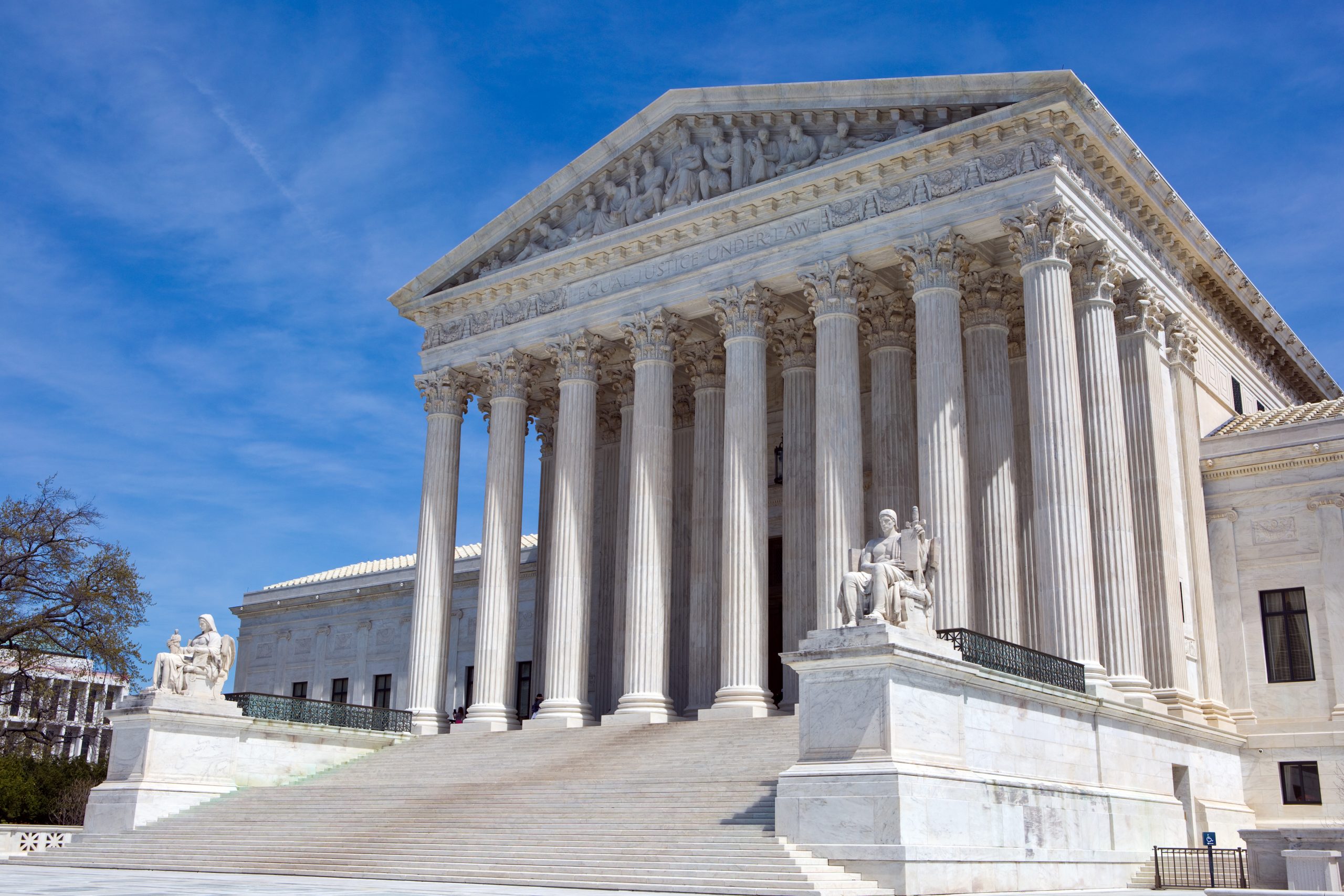
The Supreme Court began its new term on October 5. However, given the frequency of emergency orders, it hardly seemed like the justices were ever on break.
While cases involving the Trump Administration have garnered the majority of the headlines, the Supreme Court is slated to consider several significant Constitutional issues. Below are just a few of the biggest cases to watch:
Louisiana v. Callais – Voting Rights
Louisiana’s congressional map is back before the justices again. This time around, the case may decide the future of the Voting Rights Act.
Over more than two years of litigation, two separate groups of voters have challenged Louisiana’s congressional maps. The first challenge alleged that the state’s map violated §2 of the Voting Rights Act, which prohibits election practices that result in a denial or abridgement of the right to vote based on race, by diluting the votes of the state’s Black residents, which make up a third of the state’s population. To resolve the litigation, the Louisiana Legislature adopted a new redistricting map via Senate Bill 8 (SB8), which established a second majority-Black congressional district. The latest lawsuit alleges that the new map violates the Fourteenth Amendment’s Equal Protection Clause because it sorts voters predominantly by race.
A majority of a three-judge court sitting in the Western District of Louisiana enjoined SB8 as an unconstitutional racial gerrymander. In granting certiorari, the Supreme Court has agreed to address tension between the VRA and the Equal Protection Clause. The specific question before the Court is “[w]hether Louisiana’s intentional creation of a second majority-minority congressional district violates the 14th or 15th Amendments to the U.S. Constitution.”
Case v. Montana – Fourth Amendment
The case centers on the emergency aid exception to the Fourth Amendment. Officers entered William Trevor Case’s home after his ex-girlfriend reported that he had threatened suicide. Because the officers all knew Case had previously “attempt[ed] to elicit a defensive response, i.e., a ‘suicide-by-cop’” in dealings with police, they waited 40 minutes before entering the home. The Montana Supreme Court found that these facts and circumstances sufficed to reasonably suspect there was “a citizen is in need of help,” while the dissent concluded that under a probable cause standard, “the State has not met its burden of demonstrating the presence of exigent circumstances.”
In Brigham City v. Stuart, the Supreme Court held that before police officers enter a home without a warrant, they must have “an objectively reasonable basis for believing that an occupant is seriously injured or imminently threatened with such injury.” However, in the wake of the Supreme Court’s 2006 decision, the state courts and federal courts of appeals are divided over whether this “objectively reasonable basis” standard requires police making a warrantless entry to have probable cause to believe an emergency exists or some lower level of suspicion.
The specific issue before the Court is “[w]hether law enforcement may enter a home without a search warrant based on less than probable cause that an emergency is occurring, or whether the emergency-aid exception requires probable cause.”
Chiles v. Salazar – Free Speech
The case challenges a Colorado law that prohibits counseling conversations with minors that might encourage them to change their “sexual orientation or gender identity, including efforts to change behaviors or gender expressions,” while allowing conversations that provide “[a]cceptance, support, and understanding for…identity exploration and development, including … [a]ssistance to a person undergoing gender transition.”
The Tenth Circuit Court of Appeals upheld Colorado’s ban on so-called “conversion therapy,” concluding that it regulated conduct rather than speech and, therefore, need only satisfy the least stringent “rational basis” test. Its decision deepened a circuit split between the Eleventh and Third Circuits, which do not treat counseling conversations as conduct, and the Ninth Circuit, which does. The Supreme Court will now have its say, agreeing to decide “whether a law that censors certain conversations between counselors and their clients based on the viewpoints expressed regulates conduct or violates the Free Speech Clause.”
National Republican Senatorial Committee v. FEC – Campaign Finance
The Supreme Court is poised to revisit Federal Election Commission v. Colorado Republican Federal Campaign Committee, a 2001 decision in which the Court upheld federal limits on coordinated campaign expenditures, which restrict political parties from spending money on campaign advertising in cooperation with political candidates
In its opinion, the Sixth Circuit Court of Appeals acknowledged the tension between restrictions on coordinated party expenditures and the First Amendment. Nonetheless, it upheld them, citing the binding Supreme Court precedent of Federal Election Commission v. Colorado Republican Federal Campaign Committee.
In its opinion, the Sixth Circuit emphasized that in the 23 years since the case was decided, the Supreme Court “has tightened the free-speech restrictions on campaign finance regulation,” that “tension has emerged between the reasoning of Colorado II and the reasoning of later decisions of the Court,” and that relevant facts have “changed, most notably with 2014 amendments” to the limits and “the rise of unlimited spending by political action committees.” However, it ultimately concluded that “any new assessment of the validity of the limits” remained this Court’s “province, not ours.
The question before the justices is: Whether the limits on coordinated party expenditures in 52 U.S.C. § 30116 violate the First Amendment, either on their face or as applied to party spending in connection with “party coordinated communications” as defined in 11 C.F.R. 109.37.
West Virginia v. B.P.J. – Transgender Athletes
Transgender rights are a cultural and political flashpoint, particularly with regard to athletics. The Supreme Court will step into the fray later in the term when it takes up West Virginia v. B.P.J., a case challenging a West Virginia law that prohibits biological males from competing on female sports teams.
The Fourth Circuit Court of Appeals held that West Virginia’s ban violates Title IX, which prohibits sex discrimination in educational programs and activities that receive federal funding, because it discriminates against students based on sex. The Court has agreed to consider two questions: 1. Whether Title IX prevents a state from consistently designating girls’ and boys’ sports teams based on biological sex determined at birth. 2. Whether the Equal Protection Clause prevents a state from offering separate boys’
and girls’ sports teams based on biological sex determined at birth.
The Court is currently scheduled to hear a second case involving transgender athletes, Little v. Hecox, which involves whether laws that seek to protect women’s and girls’ sports by limiting participation to women and girls based on sex violate the Equal Protection Clause. Its status us unclear after Hecox asked the Court to declare her case moot because she is no longer seeking to play women’s sports.
