


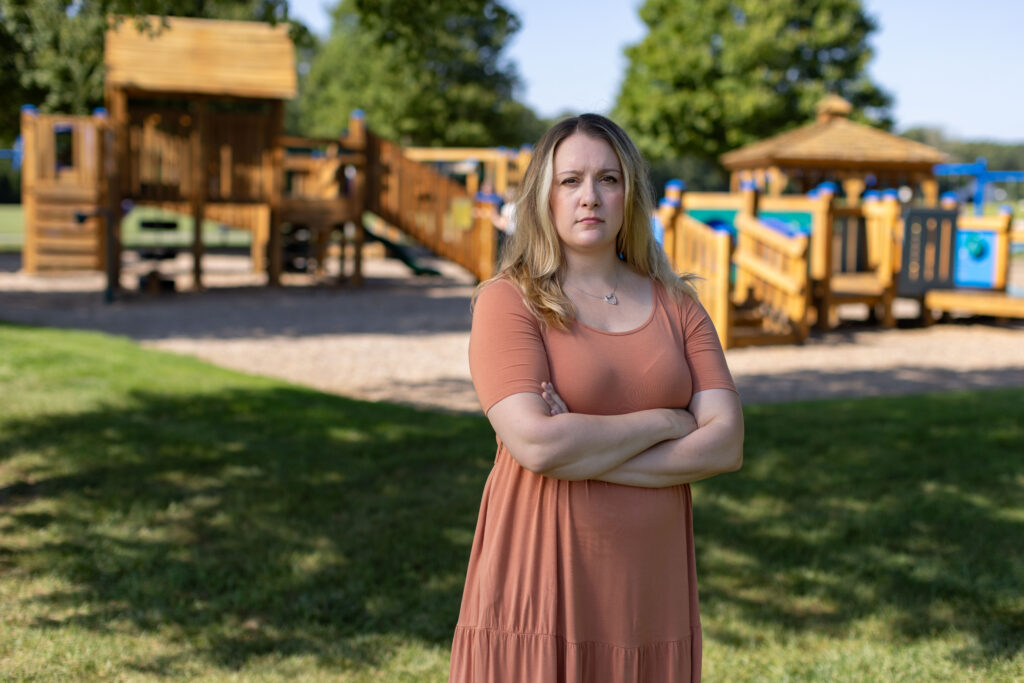
Erica Jedynak of Boonton filed a federal lawsuit against New Jersey health officials alleging constitutional violations for the state’s secretive practice of retaining blood samples it takes from newborns to detect for diseases. (Photo courtesy of the Institute for Justice)
Several parents have renewed their fight challenging the constitutionality of New Jersey’s practice of retaining blood samples from the state’s mandatory newborn disease screening program, two months after a federal judge dismissed their first lawsuit.
The parents filed an amended complaint Monday, pushing back on U.S. District Court Judge Georgette Castner’s August ruling that they failed to prove they have a possessory interest in their children’s leftover “blood spots,” which hospitals take by pricking the heels of newborns.
Attorneys representing Erica and Jeremiah Jedynak of Boonton and Hannah Lovaglio, a longtime Cranbury resident who recently relocated to Ontario, argued that the state does not have a property interest in the blood within children’s veins.
“People’s property and privacy interests in their blood and associated genetic material do not dissipate when that blood is taken physically from inside their bodies by state action,” the attorneys wrote. “Plaintiff Children, via their parents, never voluntarily gave their blood to the state, and New Jersey never sought nor received their consent. Absent such a voluntary transfer of ownership, Plaintiff Children maintain their property and privacy interests in the blood.”
The rise of artificial intelligence has made the matter especially urgent, they noted.
“Artificial intelligence has begun transforming the interpretation of genetic data, and there is a particularly heightened need to maintain privacy and control over blood and the genetic information contained within,” they wrote.
The attorneys also renewed their bid to make the lawsuit a class-action case, given that about 100,000 babies are born a year in New Jersey and are subjected to the mandatory screening. The state retains unused samples for two years for healthy babies and 10 years for newborns who test positive for disease.
Attorneys for the state have argued that retaining the blood spots allows them to use the samples for follow-up testing and develop and validate tests for new diseases, among other things.
The practice was first challenged in 2022, after the state Office of the Public Defender learned that state police had gotten a newborn’s blood spot without a warrant and used it to charge the child’s father with a crime.
The office and the New Jersey Monitor sued after state officials refused to release records showing how often and in what cases law enforcement agencies used baby blood spots to aid in criminal investigations. A Superior Court judge ordered the state in January 2023 to release the records, which showed four police departments used blood spots in five cases.
The Institute for Justice, the Virginia-based public interest nonprofit law firm, sued in November 2023 on behalf of the parents.
The state used to secretly store the blood spots for 23 years until Attorney General Matt Platkin issued a directive in June 2024 shortening the retention time, restricting how spots could be used, and requiring clearer communication with parents.
But those changes don’t go far enough, the parents and their attorneys said. Officials still have not explained what third parties may have accessed the blood spots, and the state still does not obtain informed consent from parents to take and store their babies’ blood, they said.
“As a mother, it concerns me that I have no way of knowing what the government is doing with my child’s genetic information after the initial testing period,” Erica Jedynak said in a statement. “It makes me uncomfortable knowing this information could be used by private third parties, law enforcement, or any other government agency.”
GET THE MORNING HEADLINES.
