


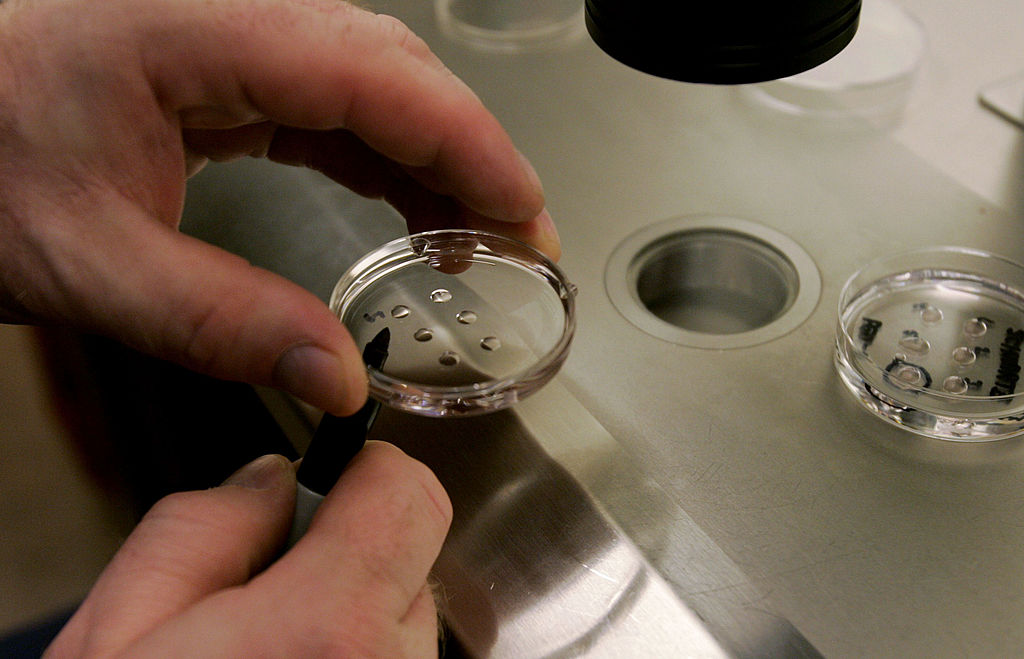
Embryologist Ric Ross holds a dish with human embryos at the La Jolla IVF Clinic February 28, 2007, in La Jolla, California. New Jersey health officials have proposed rules to license and regulate facilities that store frozen embryos and eggs. (Photo by Sandy Huffaker/Getty Images)
State health officials are moving to regulate egg and embryo storage in New Jersey, an effort to protect frozen reproductive tissues from facility failures that could ruin them.
The state Department of Health has proposed new “biobanking compliance” rules that would require cryopreservation facilities that store eggs and embryos to be licensed and establish standards for premises, equipment, recordkeeping, adverse event reporting, emergency preparedness, and quality management, among other things. Violators would face fines and license suspension, revocation, or renewal refusal.
New Jersey legislators ordered the regulations in a 2019 law in response to catastrophic 2018 failures of such facilities in Ohio and California that resulted in the loss of thousands of embryos and eggs that were stored for people who rely on in vitro fertilization and other assisted reproductive technology to start or expand their families.
The law, signed in December 2019, was required to be enacted by February 2021. But the pandemic sidetracked health officials and derailed implementation until now, said Claudia Trani-Melgar, a department spokeswoman.
Trani-Melgar said the regulations would ensure such facilities operate safely and effectively, certify that they’re prepared for emergencies and natural disasters, and decrease the likelihood of avoidable equipment failures.
“As a result, individuals and couples that utilize assisted reproductive technology will have greater confidence in the integrity of stored reproductive tissue and its availability for their future use or benefit,” Trani-Melgar said. “We are setting a gold standard that will give families peace of mind and serve as a model for states across the country.”
The rulemaking comes as states around the country are scrambling to regulate in this space, with the Trump administration increasingly restricting reproductive rights, said Jessie Losch, director of government affairs for the American Society for Reproductive Medicine.
In February, President Donald Trump issued an executive order to expand access to in vitro fertilization and gave White House officials 90 days to draft policy recommendations. But the administration has since backpedaled and seemingly abandoned the issue.
Still, that order created uncertainty and further fueled the “personhood” movement, presenting new challenges for embryo storage facilities and IVF providers, Losch noted.
Policymakers on all sides of the issue have acted. At least 17 states now have protections in place establishing fetal rights, according to the nonprofit Pregnancy Justice. Democratic-leaning states, including Rhode Island and Colorado, have followed New Jersey’s lead and are considering or have passed laws to license and regulate facilities that handle embryos, Losch said. Other states are eyeing regulations on everything from how frozen embryos should be disposed of to how long they can be stored.
Embryo and egg storage is already subject to several layers of federal oversight by agencies, including the Centers for Disease Control and Centers for Medicare & Medicaid Services, Losch said. But she welcomed state oversight too, at least now.
“We tend to say more regulation is not needed as long as you’re in compliance with existing regulations, but I think a lot of norms have flown out the window,” Losch said.
State policymakers likely will have to consider the interstate implications of egg and embryo storage too, much as New Jersey legislators acted to protect patients and providers from criminal and civil liability for getting or performing abortions in states where the procedure is restricted, Losch said.
“They may look at our existing shield law to see how that can protect shipping embryos or gametes into and out of the state,” she said. “Where states are trying to protect access (to reproductive rights), New Jersey has been leading the way.”
The Department of Health is accepting written public comment on the proposed rules on egg and embryo storage until Nov. 14. Comments can be filed online or by mail to Kimberly E. Jenkins, director of the Office of Legal and Regulatory Compliance, New Jersey Department of Health, PO Box 360, Trenton, NJ 08625-0360.
GET THE MORNING HEADLINES.
