


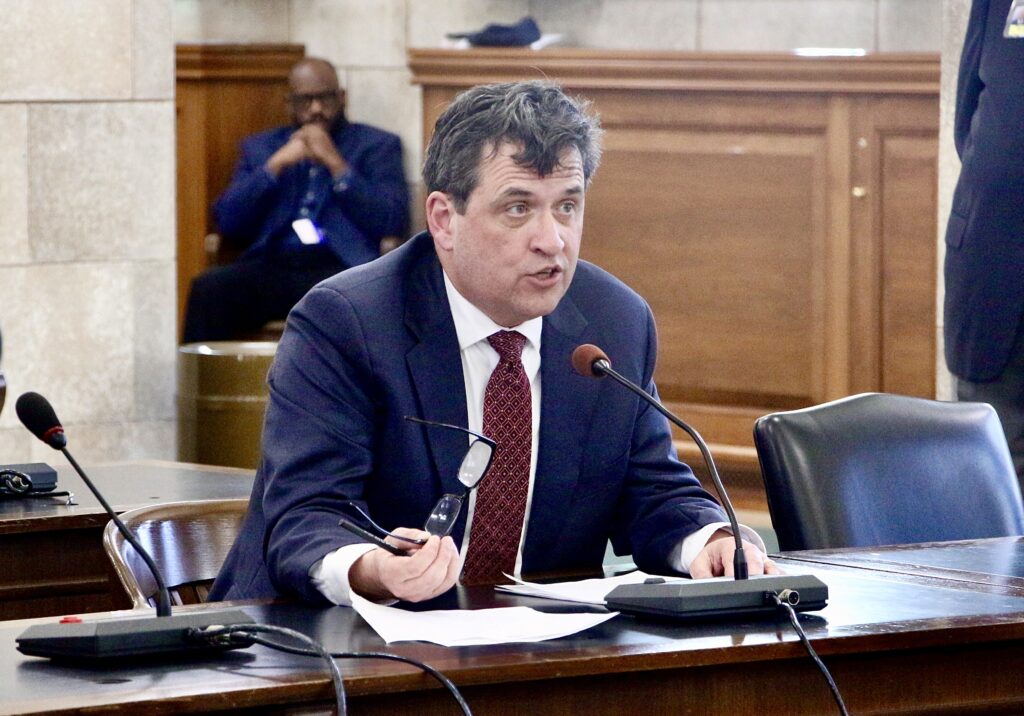
Lawyers for a politically connected insurance brokerage firm want a special counsel to investigate acting Comptroller Kevin Walsh for his recent probe into public joint insurance funds. (Dana DiFilippo | New Jersey Monitor)
A fight between New Jersey’s comptroller and a group of public joint insurance funds escalated late Tuesday when a group of the funds demanded the watchdog apologize for his recent “slanderous” investigation of the industry and accused his office of attempting to obtain confidential documents.
Their complaint echoes one made by insurance brokerage Conner Strong & Buckelew and a related entity operating under the name PERMA that alleges attorneys with acting Comptroller Kevin Walsh’s office improperly attempted to secure documents the firms said are protected by attorney-client privilege. Conner Strong, which has ties to South Jersey Democratic power broker George Norcross, wants Gov. Phil Murphy to appoint a special counsel to investigate the Office of the State Comptroller.
“Pursuant to OSC’s current policy, memorialized in both written correspondence and in recorded statements, OSC officials have repeatedly insisted that they are entitled to review attorney-client privileged materials involving the subjects of OSC inquiries, without providing any credible legal basis justifying OSC’s access to such sacrosanct information,” Deborah Gramiccioni, counsel to Conner Strong and PERMA, said in a Tuesday letter to Murphy.
The separate letter from the chairs of six health insurance funds to Murphy, legislative leaders, and regulators called for the comptroller to apologize and retract his report. They also called for a state investigation into the office and legislation to “rein in this out-of-control agency and end these abuses of power.”
Walsh’s investigations have raised the ire of multiple public and private entities, with some of them suing in state and federal courts to prevent his office from obtaining documents or releasing reports to the public.
A spokesperson for the comptroller’s office defended its most recent investigation and its officers’ conduct, saying enabling legislation provides it access to even confidential records.
“The Legislature granted OSC broad access to public documents, including confidential ones, to ensure transparency and protect taxpayer funds,” said Pam Kruger, the spokesperson. “This specifically includes reviewing attorney-client communications for public entities, among a host of otherwise confidential materials.”
In a report released Tuesday, Walsh’s office claimed it found a bevy of contracting and ethics violations related to joint insurance funds, which allow local governmental units to pool their workers to dilute risk and secure health benefits at lower prices than they could achieve on their own.
The report alleges that Conner Strong and PERMA, which holds contracts to administrate the three funds examined by the comptroller’s review, for years failed to tell regulators and joint insurance funds they are legally and practically a single business, drafted solicitations meant to exclude other vendors, and oversaw procurements they bid on.
It’s not clear what documents the comptroller’s office is alleged to have tried to obtain. According to Kruger, the insurance funds did not provide any privileged information, nor did the office compel such productions.
“This is an attempt to distract. Every fact in OSC’s report is supported by documents or recorded interviews with (health insurance fund) trustees and vendors,” she said.
The Conner Strong and PERMA letter recounts portions of emailed exchanges and interview transcripts between officials in the comptroller’s office and those at PERMA and the health insurance funds.
“As part of OSC’s procurement reviews, we may ask for documents that are otherwise confidential and/or subject to privileges, so long as the requested documents represent government records. To the extent that any responsive documents may be confidential and/or subject to a privilege, you must still provide them responsive to OSC’s request,” comptroller attorney Alysia Walsh said in a Dec. 14 email, according to the letter.
Conner Strong is one of the nation’s largest insurance firms and was founded by Norcross, who took a leave of absence from the brokerage last year after he was indicted on unrelated racketeering charges that were later dismissed by a Superior Court judge. A Norcross spokesman said this week he has not returned to the firm.
The brokerage is contracted as program manager for the funds reviewed by the comptroller. In that role, Conner Strong provides professional and other services to the funds.
Language in the comptroller’s enabling statute gives the office broad access to public documents, including those typically excluded from disclosure under the state’s Open Public Records Act so long as they are related to an audit, performance review, or contract review the office is conducting.
Documents subject to the attorney-client privilege are listed as exempt from OPRA. That could make them subject to disclosure to the comptroller if the documents were government records related to one of the office’s investigations.
Some records created by private entities holding public contracts are considered government records disclosable under OPRA, subject to relevant exemptions, said CJ Griffin, an attorney specializing in public record matters.
“If they are created for the public agency, they should be subject to OPRA unless an exemption applies. But the entire contractor itself isn’t subject to OPRA,” she said.
For example, briefs a private municipal lawyer drafts for their township would be disclosable under OPRA, while the private law firm’s own payroll records would not be subject to disclosure, said Griffin, who has represented the New Jersey Monitor in numerous legal matters.
But statute is not the only thing that governs the disclosure of documents and information shielded by attorney-client privilege. The judiciary’s Rules of Professional Conduct also set limits on such disclosures.
Court rules generally bar attorneys from revealing information related to their representation of a client, though they include exceptions that require disclosure to prevent the commission of certain crimes.
Other provisions in court rules allow, but do not require, attorneys to breach privilege to defray the impact of a client’s illegal activity that was furthered by attorney services, mount a defense in a conflict with a client or to charges stemming from a client’s behavior, prevent a client from harming themselves, or comply with other law.
“OSC’s position does seem like a broad reading of its authority. Attorney-client privilege is pretty sacrosanct,” said Griffin.
It’s not clear whether the comptroller’s ability to breach attorney-client privilege has ever been tested in court.
Assembly Speaker Craig Coughlin (D-Middlesex) and Senate President Nicholas Scutari (D-Union) declined to comment through spokespeople. Murphy spokeswoman Tyler Jones did not comment on Conner Strong’s demand for a special counsel but said the governor’s office “stands ready to work with the Legislature to reform industry practices for local government and school board health insurance funds to promote fair competition and reduce conflicts of interest.”
Murphy had a tense relationship with Norcross and the power broker’s legislative allies in his early years as governor, though their relations thawed in later years.
GET THE MORNING HEADLINES.
